


Which Debt Should You Pay Off First?

- Before you start a debt repayment strategy, make a list of all your debts, including the interest rates and balances.
- Many strategies may work. Choose the debt repayment plan that feels like the best fit for your personal finances.
- If you’re contacted by debt collectors, you could negotiate with them.
Table of Contents
Free up cash each month with Freedom Debt Relief

Ozzy S., Freedom client²
“Right away, I had more money each month because of program costs so much less than what I was paying on my minimums.”


Many people owe money to more than one lender. That situation often raises the same question: which debt to pay off first. The answer starts with your basic living expenses. Pay for housing, utilities, food, and work transportation before making any extra debt payments.
After you cover those essentials, the next step is a plan for the rest of your debt. A clear plan helps you decide where to start.
If you're current on every payment and on top of your accounts, a debt payoff plan is still worth the effort. A plan for which debts to pay off first, second, and third gives you a clear path forward and could help you save money on interest.
Prioritize Delinquent and High-Risk Debts
Delinquent accounts belong at the top of your list. These debts could hurt your credit score and, in some cases, lead to a lawsuit against you. Debt relief options, along with the payoff strategies below, could help you get current.
Secured debts, like an auto loan or mortgage, that are in delinquency are also priorities. An auto loan or home mortgage that goes unpaid for too long could mean a car repossession or a home foreclosure.
One more urgent debt priority: tax debt you owe to the government. Unpaid tax debt could mean owing additional interest and penalties, and tax debt generally survives bankruptcy. If you don't pay your taxes, the government may place a tax lien on your home or other property. A tax lien gives the government a legal claim against your property to secure the unpaid tax debt. The IRS offers payment plan options for taxpayers who owe more than they're able to pay right away.
Unpaid tax debt could bring severe and painful problems. Government authorities are generally easier to work with if you communicate with them early. Tax debt has many solutions that could fit your budget and help you move forward.
If you're going through financial hardship, like a serious medical problem, lost job, long-term unemployment, or the death or disability of a spouse or main breadwinner, it's even more urgent to prioritize your debts. To decide which debt you should pay off first, ask yourself if this unpaid debt could:
Cause you to lose your home or property? If you're delinquent on your home mortgage or auto loan, prioritize these debts first so you don't lose your home or vehicle.
Get you in trouble with the government? If you owe money to the IRS or state tax authorities, put that at the top of your list.
Be handled in other ways, like debt relief? Some debts, like credit card debt and unsecured personal loans, may be negotiated and settled through debt settlement programs or other debt relief options. If you have several unpaid debts, you might want to put your credit card debts on the back burner and focus on keeping your home and car.
People without delinquent debts still need to decide which debt to pay off first. A plan and organized records could help you save money on interest and fees, get rid of debt faster, and build a stronger financial future.
There isn't one best way to get rid of debt. The best time to start is now.


How to Choose Which Debt to Pay Off First
Many people choose to start with either the most expensive debt or the smallest outstanding balance.
For example, if you have three credit cards with interest rates of 25%, 27%, and 29%, you might want to pay off the highest-interest card first. Or if you have an auto loan with $2,500 left on it and $5,000 each on two credit cards, you might decide to pay off the smallest balance first, even if it's at a lower interest rate.
This choice takes some thought. To decide, you need to understand the type of debt you have, its cost, and its outstanding balance. Gather your debt information, including mortgages, student loans, auto loans, personal loans, and credit cards.
Secured vs. unsecured debt
A secured debt is backed by an asset, called collateral, that you offer the lender to get the loan. Mortgages, home equity loans and HELOCs, and auto loans are common examples, because a home or vehicle secures the debt. Secured debts generally carry lower interest rates than unsecured debts, since the collateral protects the lender. If a secured debt goes unpaid, the lender may seize and sell the asset to recover the balance, for example, through mortgage foreclosure or auto repossession.
An unsecured debt has no collateral behind it. Personal loans, student loans, and traditional credit cards are common examples; the lender relies on your credit history and your promise to repay instead of an asset. Unsecured debts generally carry higher interest rates, since the lender takes on more risk. Unpaid unsecured debt doesn't put your home or car at risk. It could still lead to added interest, fees, credit score damage, or a lawsuit.
Whether to pay off secured or unsecured debt first often comes down to your finances and your peace of mind. For example, someone with a 7% auto loan and 25% credit card debt often comes out ahead paying down the credit card first, while the car loan continues at its regular pace.
If you're delinquent on a secured debt, address it first to protect your home or car, even if that means paying only the minimum on unsecured debts.
If your secured debts carry low rates and your unsecured debts carry much higher rates, paying down the unsecured debt first generally saves more money.
Unsecured debt that's delinquent may be negotiated and settled through debt settlement programs or discharged in bankruptcy, so you may have options that don't put your home or car at risk.
Cost of debt and outstanding balance
The cost of a debt is best measured by its interest rate. Your annual percentage rate (APR) includes the interest rate plus fees, so it's a useful way to compare debts. Write down the APR for each debt so you know which ones cost you the most over time.
Know your outstanding balance and minimum payment for each debt. Credit card minimum payments drop as your balance drops, but a lower minimum payment means a longer payoff timeline. It's best to keep paying the same amount each month, even if your card issuer allows a lower payment. Installment loan minimum payments, like those on a mortgage or auto loan, typically stay the same until payoff.
Looking for debt relief in Indiana or across the country? The first step is the most important one—learn more.
Debt Payoff Strategies
Once you know the details of your debt, choose a debt repayment plan that suits you. Let's assume you have the following credit card debts:
Which debt to pay off first - example of credit cards
| Debt | Outstanding balance | APR |
|---|---|---|
| Credit card A | $20,000 | 24% |
| Credit card B | $10,000 | 19% |
| Credit card C | $5,000 | 22% |
Let’s say the minimum payments are $600, $259, and $142 (calculated as the interest plus 1% of the balance). You’re paying $1,001 per month, and a debt payoff plan works best if you keep paying that same amount until all debts are cleared.
Debt snowball: the smallest debt first
With the debt snowball method, you pay off your smallest balance first and work up to the largest. This method offers a psychological win instead: watching that first balance reach zero could help keep you motivated.
Using the example above, you'd make minimum payments on cards A and B while putting any extra money toward card C, the smallest balance. Once card C is paid off, you'd roll that payment into card B, then card A, until every balance is paid off.
The debt snowball method is good for most people. It’s the fastest way to your first debt payoff, and doesn’t require you to track interest calculations. Studies have shown that people who knock down smaller debts first tend to stick with their plan longer and have greater success than people who use the mathematical approach of the avalanche method.
Debt avalanche: the highest interest rate first
With the debt avalanche method, you pay off the debt with the highest interest rate first. The goal is to get rid of the most expensive debt first, which could save you on interest charges over the long run.
Using the example above, you'd make minimum payments on cards B and C while putting extra money toward card A, the highest rate. Once card A is paid off, you'd move to card C, then card B.
For this level of debt, at these rates and if you can pay an extra $100 per month, the avalanche could save you about $466 at the end of nearly five years. The avalanche and snowball methods take the same amount of time. You’ll save the money when you’re at that final payment.
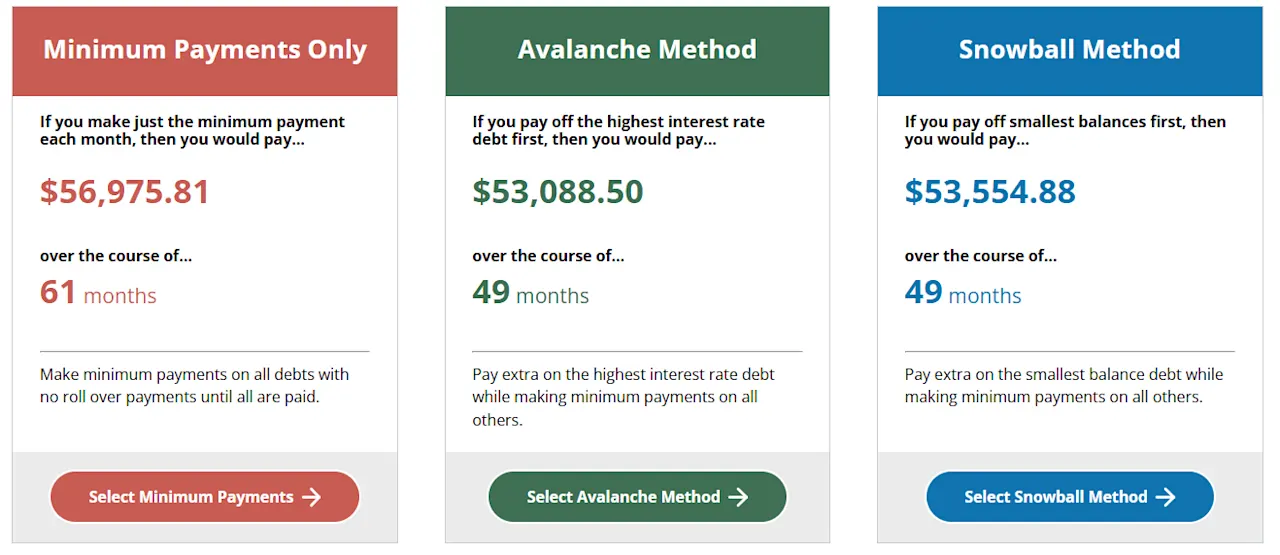
Source: finred.usalearning.gov
Debt consolidation loans
Debt consolidation uses one loan to pay off multiple debts, often at a lower interest rate. It could simplify your finances by turning multiple payments into one. Here are three common ways to consolidate debt.
Personal loan. A personal loan used as a debt consolidation loan could offer a lower rate than credit cards if your credit is fair or better, and it's typically unsecured, so your home or car isn't at risk. The tradeoff: the debt doesn't go away. It moves to a new account. A common pitfall is to run up new balances on the credit cards you just paid off.
Home equity loan or HELOC. A home equity loan or home equity line of credit (HELOC) borrows against the difference between your home's value and your mortgage balance. Rates are typically lower than credit cards or personal loans. The loan is secured by your home, so missed payments put your home at risk of foreclosure.
Credit card balance transfer. A balance transfer moves your balances to a new credit card, often with a low or 0% introductory interest rate for a period of time, plus a transfer fee of about 4% to 5%. Balance transfers could meaningfully cut your interest costs. The rate jumps up once the introductory period ends, and qualifying generally requires fair or better credit.
Debt consolidation tends to work well if you have multiple high-interest debts, want a single simpler payment, and qualify for a lower rate. It's generally not the right fit if your debts are already delinquent or you'd rather avoid the temptation to take on new balances on paid-off cards.
Common consolidation mistakes:
Credit card accounts left open after consolidation, which often leads to new balances.
A balance remaining at the end of the introductory period, when the rate increases.
A home equity loan used to pay off credit cards, followed by missed mortgage payments, which risks foreclosure.
Alternative Debt Payoff Methods
Beyond the debt snowball and debt avalanche, a few other approaches could work depending on your priorities:
Debt by type: Pay off one category, like credit cards, before moving to auto loans, then student loans.
Highest payment: Pay off the debt with the largest minimum monthly payment first.
Credit utilization: Pay down cards with higher balances first to help your credit score.
Emotional priority: Pay off the debt that feels most urgent to you.
Hybrid approach: Pay extra toward more than one debt at a time instead of following a single method.
There's no single right approach as long as you stick with your plan and your balances keep shrinking.
Methods to avoid:
Frequent balance transfers, which may lead to rising credit card debt
Minimum payments only, which generally means paying more in interest over a longer period.
Retirement account withdrawals, since that money is difficult to replace later.
Random debt payments without a plan to guide your progress.
Pros and cons of debt repayment strategies
Which debt to pay off first pros and cons
| Repayment strategy | Pros | Cons |
|---|---|---|
| Debt avalanche | Lower cost | Possibly longer time to first payoff |
| Debt snowball | Faster time to first payoff Motivating | Higher overall cost |
| Debt consolidation loan | Simplify payments Potentially lower overall cost | May take longer to pay off debt Might not save money if you take more years to pay |
Which debt repayment method should you choose?
The best debt repayment strategy depends on your finances and your personal style of managing money. Choose the method you're most likely to follow through on.
Create Your Debt Payoff Plan
Now that you know the ins and outs of debt payoff plans, it's time to build your own. Here's a quick step-by-step guide:
List and organize your debts. Gather your latest balances, interest rates, and minimum payments from your credit card and loan accounts into one place, using a notepad or spreadsheet.
Use tools and debt calculators. Free apps and calculators, like the Achieve GOOD app and Undebt.it, help you track your progress and estimate your payoff timeline.
Set realistic timelines. Paying off debt generally takes months or years of steady progress. A debt calculator helps you estimate your timeline.
Review your budget. Review your budget for extra money to put toward debt each month, which could speed up your payoff timeline.
Monitor your progress. Monitor your balances as they go down, make extra payments when you find additional cash, and celebrate milestones along the way.
Debt relief by the numbers
We looked at a sample of data from Freedom Debt Relief of people seeking credit card debt relief during February 2026. This data reveals the diversity of individuals seeking help and provides insights into some of their key characteristics.
Credit utilization and debt relief
How are people using their credit before seeking help?
Credit utilization measures how much of a credit line is being used. For example, if you have a credit line of $10,000 and your balance is $3,000, that is a credit utilization of 30%. High credit utilization often signals financial stress.
We have looked at people who are seeking debt relief and their credit utilization. (Low credit utilization is 30% or less, medium is between 31% and 50%, high is between 51% and 75%, very high is between 76% to 100%, and over-utilized over 100%). In February 2026, people seeking debt relief had an average of 74% credit utilization.
Here are some interesting numbers:
Credit utilization for debt relief seekers
| Credit utilization bucket | Percent of debt relief seekers |
|---|---|
| Over utilized | 30% |
| Very high | 32% |
| High | 19% |
| Medium | 10% |
| Low | 9% |
The statistics refer to people who had a credit card balance greater than $0.
You don't have to have high credit utilization to look for a debt relief solution. There are a number of solutions for people, whether they have maxed out their credit cards or still have a significant part available.
Student loan debt – average debt by selected states.
According to the 2023 Federal Reserve Survey of Consumer Finances (SCF) the average student debt for those with a balance was $46,980. The percentage of families with student debt was 22%. (Note: It used 2022 data).
Student loan debt among those seeking debt relief is prevalent. In February 2026, 27% of the debt relief seekers had student debt. The average student debt balance (for those with student debt) was $48,703.
Here is a quick look at the top five states by average student debt balance.
Next 2 - Student debt by states
| State | Percent with student loans | Average Balance for those with student loans | Average monthly payment |
|---|---|---|---|
| District of Columbia | 34 | $71,987 | $203 |
| Georgia | 29 | $59,907 | $183 |
| Mississippi | 28 | $55,347 | $145 |
| Alaska | 22 | $54,555 | $104 |
| Maryland | 31 | $54,495 | $142 |
The statistics are based on all debt relief seekers with a student loan balance over $0.
Student debt is an important part of many households' financial picture. When you examine your finances, consider your total debt and your monthly payments.
Regain Financial Freedom
Seeking debt relief can be the first step toward financial freedom. Are you struggling with debt? Explore options for debt relief to regain control of your finances. It doesn't matter how old you are or what your FICO score or credit utilization is. Take the first step towards a brighter financial future today.
Show source
Author Information

Written by
Thilini Wijesinhe
Thilini Wijesinhe is a writer specializing in personal finance, investing, and other financial topics. She is a financial industry insider, with expertise in funds management, investment analytics, financial analysis, and more. Thilini is an Associate Member of the Chartered Institute of Management Accountants (CIMA) UK and holds a Master of Arts in Financial Economics from the University of Colombo, Sri Lanka.

Reviewed by
Christy Bieber
Christy Bieber has been writing about personal finance and law for 16 years. She has a JD from UCLA School of Law with a focus on business law, and a BA in English, Media & Communications from the University of Rochester, as well as a Certificate of Business Administration.
Frequently Asked Questions About Debt Payoff
Do you need good credit for debt consolidation?
Generally, yes. If you want a personal loan for debt consolidation, you’ll need at least a fair credit score (probably 670 or higher). If you own a home, you might be able to get a home equity loan for debt consolidation with a credit score of at least 600. If you have a poor credit score, you might not qualify for a loan and would want to look at a debt management plan or a debt settlement program.
When is it a good time to take a loan to pay off credit cards?
The best time to take out a loan to pay off credit cards may be when you're ready to streamline payments, you're committed to not using your cards to make new purchases and you're able to qualify for a better rate than you're currently paying. Comparing personal loan options and prequalifying risk-free can tell you what loan terms you're likely to be offered.
What makes someone a good fit for debt consolidation?
For starters, combining multiple debts into one could help you organize your payments. If you can find a lower-interest debt consolidation loan, it could also reduce your interest costs. Another way debt consolidation might help is by stretching repayment over a longer time. This could lower your monthly payments.
Which debt payoff method is mathematically best?
The debt avalanche method is usually the mathematically best debt payoff plan, because it pays down your highest interest debt first and fastest. That saves you more money in total interest. Not everyone wants to use this method, and that’s okay. Sometimes other plans like the debt snowball method can be more emotionally rewarding and motivating. Use debt payoff calculators to check the math for your specific debts and interest rates.
How do I stay motivated during debt payoff?
A few ideas to stay motivated are: use debt payoff apps and calculators to visualize your progress. Mark your debt payoff date on a calendar. Celebrate little victories and milestones along the way, like “As of today, I have paid off $1,000 of debt!” You might also want to get an accountability partner, like a close friend who is also trying to improve their finances, and you can help each other stay on track, like a workout buddy for getting rid of debt.
Should I use my emergency fund to pay off debt?
Most financial advisors will likely encourage you to keep at least a little bit of money in cash as an emergency savings fund, even if you have credit card debt. Having some cash on hand in a bank savings account could help you avoid financial emergencies like an expensive car repair or an eviction from your home. Even if you only have $1,000 or $500 of cash in the bank, you might want to leave it alone. Instead of draining your savings, look for other options to get rid of debt, like using your future income to pay it off, or getting professional help with debt relief.
How does debt payoff affect my taxes?
Paying off most consumer debts like credit cards or personal loans shouldn't affect your taxes. The interest on these debts isn’t tax deductible, and you shouldn’t have to report any details about these debts on your tax return. Some debts do affect your taxes—for example, if you’re able to claim a tax deduction for home mortgage interest or auto loan interest. If you have debts with tax-deductible interest, you might not want to be in a hurry to pay off those debts faster. Also, if you have debts forgiven by lenders, this could mean additional income that you’ll report to the IRS. Talk with a professional tax advisor if you have questions about your specific tax situation.

Credit Card Debt
