

Virginia Debt Relief by the Numbers: 5-Year Debt Trends
Household debt in Virginia is at its lowest point since the Great Recession in 2007, with the average household owing about $75,700 in total debt in 2024 according to Federal Reserve of New York data. That's around $22,300 less than the 2007 peak.
Changes to the average household debt in Virginia have very closely mirrored changes to average household debt in the U.S. overall—though the figure is quite a bit higher. Virginians owe an average of $14,000 more in household debt than the average U.S. resident.
While they owe more debt, Virginians do have higher median incomes; the median household income for Virginia in 2024 was $92,090. This puts them $10,500 ahead of the U.S. median, or about 13% higher.
Despite higher median incomes, many Virginians seem to be struggling with their higher debt levels. Freedom Debt Relief data shows that debt relief seekers in the state are consistently more likely to have at least one account 30 days or more past due.
Freedom Debt Relief does not provide debt settlement services for people in Virginia. They may be referred to a third party provider or law firm.
Virginians can free up cash each month with Freedom Debt Relief

Ozzy S., Freedom client²
“Right away, I had more money each month because of program costs so much less than what I was paying on my minimums.”

5-Year Debt Trends in Virginia
Overall household debt levels may have trended lower, but Virginians in need of debt relief have not had the same experience. Freedom Debt Relief data shows that debt levels are up for both secured debt (debt requiring collateral or something of value to back it up, like a mortgage) and unsecured debt (debt with no collateral, like most credit cards).
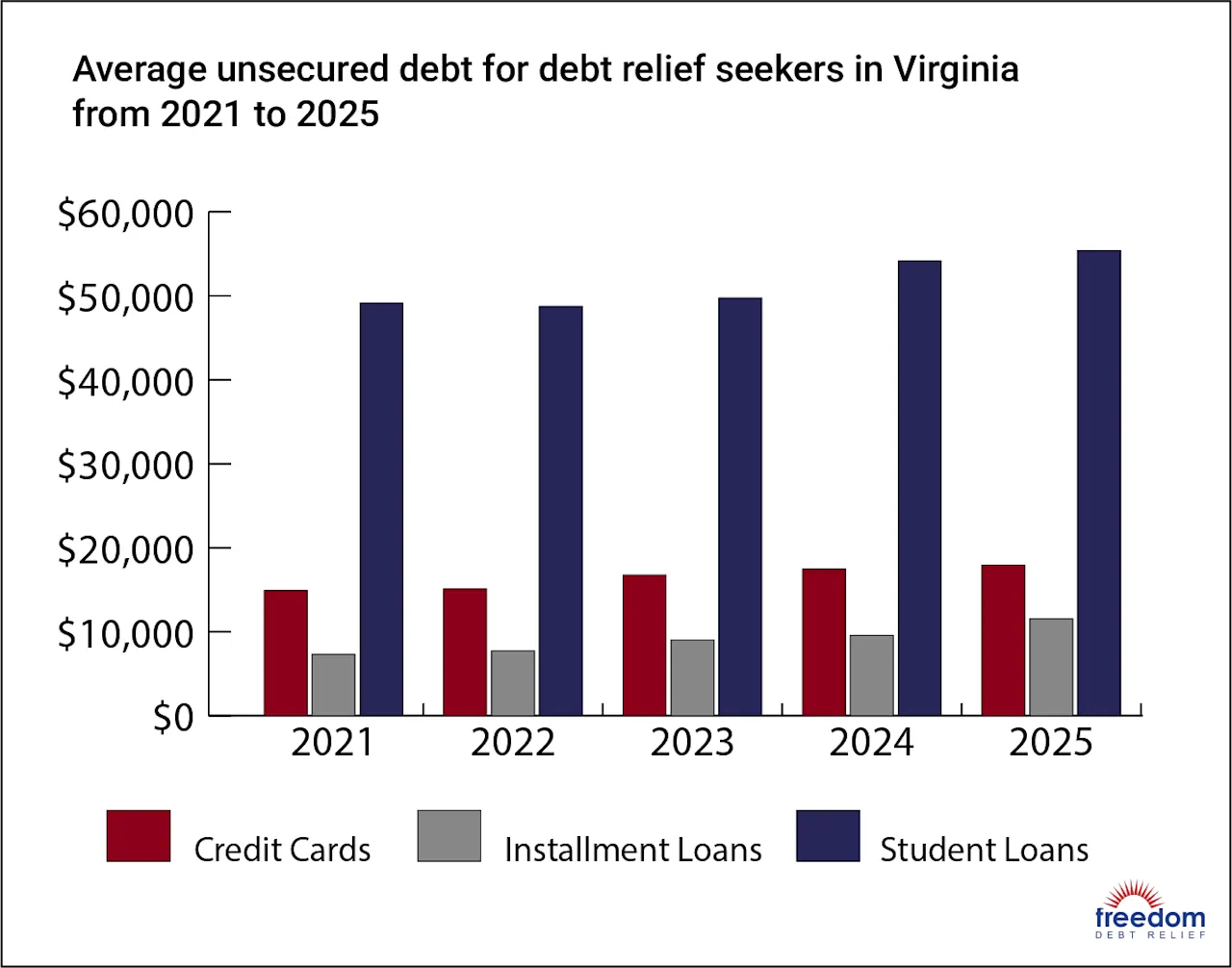
Unsecured debt has had the largest growth for Virginia debt relief seekers. Personal installment loan debt has seen the largest jump, with an 37% increase from 2021 to early 2025. Credit card debt has also seen significant increases, jumping by more than $3,000 in the same time period. Student loans showed the most modest growth, increasing 11% since 2021.
Secured debt has also grown since 2021, though not as quickly or as much. Auto loan debt increased by about 8% from 2021 to the first half of 2025. Mortgage debt saw the same percentage increase as student debt at 11% during the same time.
Perhaps a spot of good news is that collections debt has actually decreased from 2021 to early 2025. Virginia debt relief seekers have about 32% less debt in collections in the first half of 2025 than they did in 2021. They're also significantly less likely to have five or more accounts in collections—19% in 2021 versus just 3% in 2024.
Overall, U.S. debt relief seekers have seen similar trends, with debt relief seekers owing more across the board in early 2025 than in 2021. As with Virginia, U.S. debt relief seekers saw the largest jumps in installment loans and credit card debt, with student loans and secured debts showing slightly more modest jumps.
Virginia credit card debt
Credit card debt is a growing problem for debt relief seekers in Virginia. Average credit card balances have grown each year since 2021's low of $14,927. Halfway through 2025, debt relief seekers in Virginia owed an average of $17,959 in credit card debt.
They're also increasingly falling behind; Virginia debt relief seekers have $1,849 more credit card debt that's past due in early 2025 than they did in 2021.
Residents have that debt spread across slightly more cards; the average number of credit cards per person grew from 7 cards in 2021 to 7.2 cards in early 2025. That's lower than the peak of 7.6 cards per person on average in 2023, however. It's also lower than the national average of 7.4 cards per debt relief seeker in early 2025.
How much of their credit limits they're using has been up and down, but not by a lot. Virginia debt relief seekers had an average credit card utilization—total credit card balances divided by total credit available credit—of 74.9% in 2021. That dipped to a low of 71.9% in 2021, then up to a peak of 75.5% in 2024. Halfway through 2025, it was down again slightly at 73.4%, just barely below the national average of 73.5%.
Virginia auto loan debt
The average price of a vehicle has been steadily increasing, but Virginian's auto debt hasn't been quite as dramatic. Debt relief seekers in the state saw a moderate 8% jump in auto debt between 2021 and the first half of 2025, growing from $24,236 to $26,401.
That's actually quite a bit less than the 15% increase for U.S. debt relief seekers overall. Despite a slower rise, Virginia debt relief seekers only owed about $600 less in auto debt in early 2025 than U.S. debt relief seekers overall. If anything, it's a sign of some equalization, as Virginians owed more auto debt on average in 2021 than other U.S. debt relief seekers.
Oddly, while total debt had a somewhat smaller rise, monthly payments have increased by around 16%. The average monthly auto loan payment for debt relief seekers in Virginia rose from $606 in 2021 to $724 in early 2025.
Virginia mortgage debt
Housing costs are a bit above average in Virginia, with the median home price just shy of half a million dollars. This comes in about 7% higher than the national median of $462,206, or a difference of about $37,200.
Mortgage debt numbers mirror this situation fairly closely for debt relief seekers in Virginia and the U.S. overall. The average debt relief seeker in Virginia owed $266,411 in mortgage debt in the first half of 2025. Compared to the $239,406 average mortgage debt for debt relief seekers nationwide, Virginians owe about 9% more.
While total mortgage debts are similar, monthly payment amounts are actually almost identical. The average Virginia debt relief seeker pays $2,037 toward mortgage debt each month, just 2% higher ($48 more) than the $1,989 typical across the U.S. overall.
Virginia installment loan debt
The largest category for debt growth both in Virginia and the U.S. overall has been installment debt, though Virginia actually saw a larger jump than was typical nationally. U.S. debt relief seekers started and ended with more total debt, however.
Debt relief seekers in Virginia had an average of $7,308 in installment debt in 2021. Installment debt jumped a whopping 37% percent between 2021 and the first half of 2025. That's an extra $4,231 in installment debt on average. Total installment debt rose for U.S. debt relief seekers overall from $8,581 in 2021 to $12,632 in the first half of 2025 for an average 32% increase.
The number of loans rose as well, though not as dramatically. The average Virginia debt relief seeker had 2.8 loans per person in 2025, up from 2.5 per person on average in 2021. Overall, the jump was even smaller, rising from 2.7 loans per debt relief seeker to 2.8 loans.
Virginia student loan debt
Student loan debt has always been a nationwide problem, and the data for Virginia helps illustrate this. The total debt owed by Virginia debt relief seekers has grown by 11% from 2021 through the first half of 2025—only 3% less than the national average growth of 13%.
While student debt balances grew slightly more slowly for Virginia debt relief seekers, totals owed have been higher than the U.S. average each year, though the gap shrank slightly in 2025. Data from the first half of the year shows Virginia debt relief seekers owe an average of $55,390 in student debt across 5.3 loans. That's 10% higher than the U.S. average of $49,932 across 5 student loans.
Virginia Debt Delinquencies and Collections
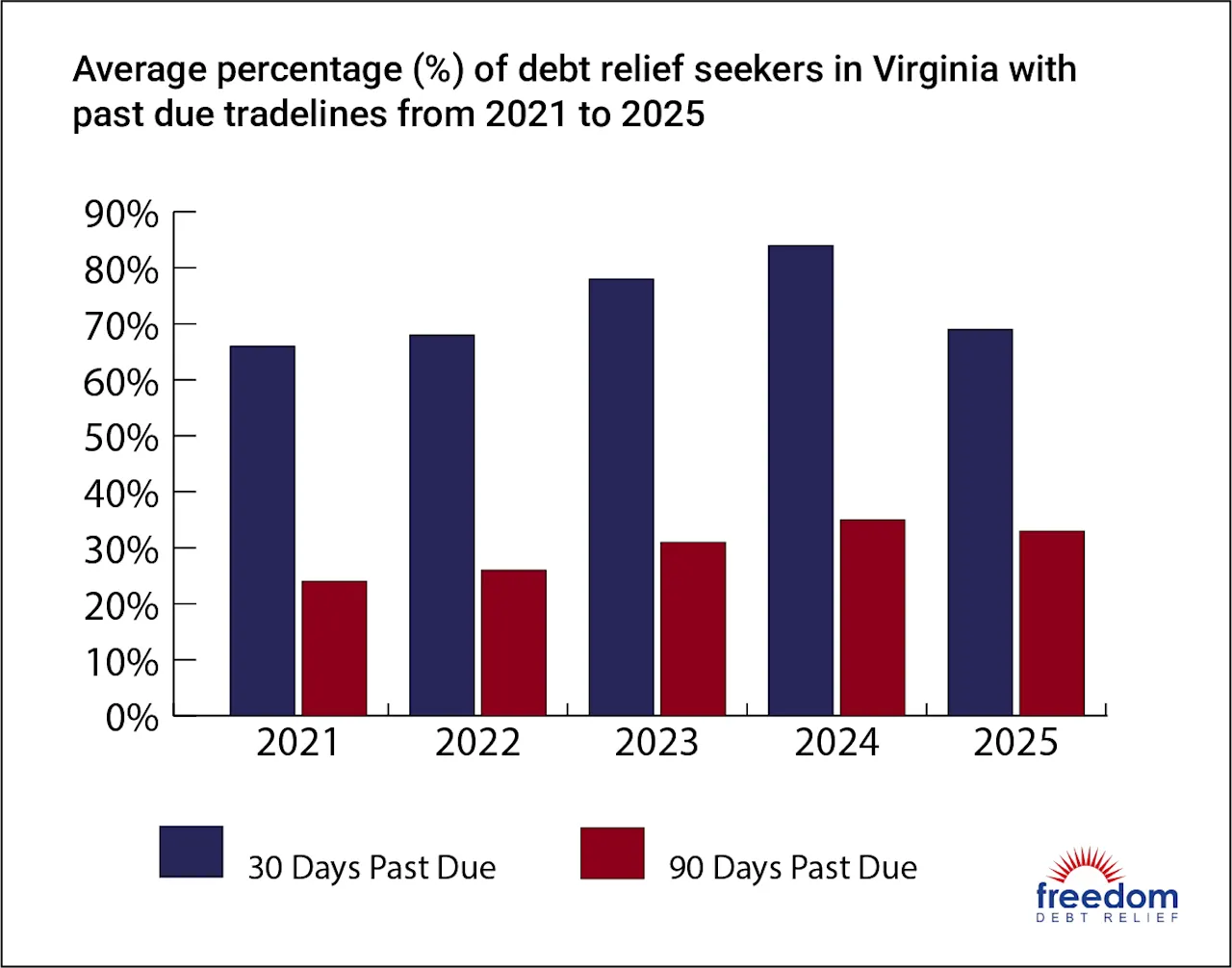
Given that debt has risen almost across the board in Virginia, it's little surprise that more people are falling behind on that debt. An average of 84% of Virginia residents seeking debt relief in 2024 were behind on at least one tradeline, an increase of 18% over 2021 numbers.
The number had decreased to 69% halfway through 2025, but the larger debt amounts for the same period could indicate past-due accounts will rise as the year progresses. Roughly a third of debt relief seekers are even worse off with at least one account 90 days past due.
Credit card debt is particularly troublesome for many debt relief seekers, both in Virginia and nationwide. Virginians were behind on an average of $5,824 in credit card debt in early 2025, slightly over the national average of $5,793 among debt relief seekers.
Although they're behind on almost a third of their credit card debt, Virginia debt relief seekers had less collections debt in the first half of 2025 than they did in 2021. Total collections balances decreased from $3,622 to $2,481, or 32%. The number of trade lines in collections also dropped from a high of 3.8 accounts on average per debt relief seeker in Virginia down to 1.7 accounts on average.
Virginia Statute of Limitations
If you're a resident of Virginia and fall behind on your debts, you could be taken to court by your creditor or by a debt collector who buys your debt. The window during which you can be sued is known as the statute of limitations. Once the statute of limitations expires, you generally can't be successfully sued over the debt, though debt collectors can still use other means to try and collect.
In Virginia, the statute of limitations varies depending on the nature of the contract. In general, most debts have a statute of limitations of five years:
VA Statute of Limitations for Debt
| Type of debt contract | Virginia statute of limitations |
|---|---|
| Oral contracts | 3 years |
| Written contracts | 5 years |
| Credit card debt | 5 years |
| Personal loans | 5 years |
| Judgments | 10 years after July 1, 2021; 20 years before July 1, 2021 |
What are the Virginia debt collection laws?
Most of the regulations in Virginia for debt collectors are set by the federal Fair Debt Collection Practices Act (FDCPA). They cover when and how debt collectors can contact you, as well as offering protections about what debt collectors can say. Some notable protections include:
Debt collectors can't use threats of violence or profane language when contacting you. They also can't threaten arrest if you don't pay them.
Debt collectors shouldn't contact you before 8:00 am or after 9:00 pm unless you give them permission.
Debt collectors aren't allowed to tell your employers or other third parties about your debts.
Virginia also has a criminal statute that makes it illegal for anyone trying to collect a debt from simulating any legal process, such as a notice of lien or motion of judgement. Violators could be fined.
The state recently enacted a new Medical Debt Protections Act that is set to go into effect in July 2026. It provides additional protections for medical debts, including restricting interest and late fees for the first 90 days.
Reviews and Testimonials from Virginia
So far my experience with them has been excellent I am getting my debt down with there help. They have worked tirelessly to negotiate on my behalf and I feel I am on my way to becoming debt free. I have a ways to go but feel confident I will make it with their help
cynthia jackson, US

Freedom has been very good at negotiations with my creditors to get my debt as low as possible, and help me pay them off. They keep my payments low and affordable.
Paula Ryals, US
I’m a very honest person and a older person and i trust your company will be honest and help me.i hope during yhe next fews months i will be able to work O/T and can increase my money so i can get it paid off sooner. I’m not the smartest person when it comes to technology. So please be patient. With me. Be blessed and thanks for your help.
Hope Mcneill, US
Virginia Debt Relief
The typical Virginia debt relief seeker has almost $18,000 in credit card debt, and they're already behind on almost a third of that debt. They're using nearly three-quarters of their available credit card credit limits and have an average monthly debt payment of almost $2,000.
Every year, thousands of Virginia residents contact Freedom Debt Relief for help with their debt—and that number more than tripled between 2021 and 2024. They're all seeking the same thing: relief from overwhelming debt.
Debt relief is typically synonymous with debt settlement, the process of negotiating with your creditors to get rid of your debt. If you're behind on your bills, your creditors could be open to settling your debt for less than you owe.
While not for everyone, debt settlement can help some people save money on their debt. If you're tired of feeling overwhelmed by your debt, it may be time to make your move. Contact Freedom Debt Relief to discuss your options for debt relief and get your finances back under control.
Freedom Debt Relief does not provide debt settlement services for people in Virginia. They may be referred to a third party provider or law firm.
Virginia Debt Relief: Settlement vs. Consolidation?
Is Debt Consolidation the Best Debt Solution?
One popular option for debt relief seekers in Virginia is debt consolidation, which involves using a new loan to pay off existing debt. Consolidation could be a good option if you're still current on your debts and your credit history is good enough to qualify for a lower interest rate than you're paying right now.
Here's how debt consolidation typically works:
You apply for a loan at a lower interest rate than the rates you currently pay on your credit cards.
If you’re approved, you use the loan to pay off your existing debts.
You then make monthly payments on the new consolidation loan.
In the best case, consolidation simplifies your finances and lowers your monthly debt payments. Not everyone will qualify for a lower rate, however, and consolidation rarely makes sense if you can't reduce your interest rate.
If consolidation isn't in the cards, consider these alternative options for debt relief in Virginia:
Hardship programs: A financial hardship program is a plan designed by your creditor to give you a break from making payments. Creditors use different strategies, including forbearance, deferred payments, or loan modification. Creditors offer hardship programs because they don't want you to abandon the debt entirely.
Income-driven repayment plans: Income-driven repayment plans (IDRs) are typically used to lower federal student loan payments according to your income and family size.
Debt settlement: Debt settlement involves convincing unsecured creditors (like credit card companies) to accept less than you owe as payment in full.
Credit counseling: Credit counseling is for people having trouble paying unsecured debts like credit cards or medical bills. A credit counselor may suggest a debt management plan if you can afford to fully repay your unsecured debts in three to five years. It’s a possible option if you can afford your debt but you can’t get a handle on it by yourself.
Bankruptcy: Bankruptcy is a legal process for those who can't pay their debts without significant hardship. The bankruptcy court decides how much you can afford to pay your creditors. That sometimes means paying less than the total amount owed, although that's not always true.
Virginians can free up cash each month with Freedom Debt Relief
Ozzy S., Freedom client²
“Right away, I had more money each month because of program costs so much less than what I was paying on my minimums.”
Frequently Asked Questions
What are the main types of debt relief options available in Virginia?
Residents of Virginia can get debt relief through a few methods:
Debt consolidation: If you qualify for a lower rate, consolidating your debts with a new loan could lower your monthly debt payments.
Hardship programs: These are sometimes offered by credit card companies or other creditors and are designed to provide temporary relief when facing financial hardship like job loss, reduced hours, or a medical emergency.
Debt settlement: If you're behind on your payments, your creditors may accept less than you owe to settle your debt. You can DIY the negotiations or hire a debt settlement company.
Credit counseling: Credit counseling agencies could help you set up a debt management plan (DMP), which is a structured debt repayment plan. They may also negotiate with your creditors to reduce your interest rate or get fees waived.
Bankruptcy: Chapter 7 bankruptcy could get rid of your unsecured debt if you qualify (it is income-limited). Chapter 13 bankruptcy could help you restructure your debt and avoid foreclosure.
How does Chapter 7 bankruptcy work in Virginia as of 2025?
Filing Chapter 7 bankruptcy in Virginia requires the same steps as filing in other states. Here's a brief rundown:
Consult an attorney. Decide if you want an attorney to help you file.
Credit counseling. Take an approved credit counseling course within 60 days before filing.
Print forms. Download the official bankruptcy documents from USCourts.gov.
Fill out your forms. Be sure to sign where required.
File your petition. Submit your paperwork to the correct district. Virginia has two bankruptcy districts: Eastern District and Western District.
Pay your filing fee. You may qualify for a fee waiver if your income is below 150% of the federal poverty guideline.
Trustee appointment. The bankruptcy trustee will review your case.
341 Meeting. This gives your creditors a chance to ask questions.
Debtor education course. Take an approved financial management course within 60 days after the 341 meeting.
Discharge of debts. The court will decide if you which, if any, of your debts will be discharged.
What are the requirements for debt consolidation loans in Virginia?
The specific requirements for a debt consolidation loan in Virginia depend on the lender and type of loan. That said, here are some general requirements:
Home equity loans typically require fair credit and an LTV below 80%. A FICO credit score of 600+ is recommended. Home equity loans are secured loans backed by your property, so they're less risky for the lender. You'll likely need to have a loan-to-value (LTV) ratio less than 80%. You can find your LTV by dividing your mortgage balance by your home's value.
Personal consolidation loans typically require fair to good credit and a DTI below 50%. A FICO credit score of 660+ is recommended. Personal loan lenders will consider both your credit history and your debt-to-income (DTI) ratio. Your DTI is calculated by dividing your total monthly debt payment by your gross (pre-tax) monthly income. A lower DTI is better; 35% is usually considered good, while a DTI over 50% could complicate getting a loan.
How to find the best non-profit credit counseling services in Richmond, Virginia?
You have a few resources for finding nonprofit credit counseling services in Virginia. Here are some strategies:
Check with national accreditation organizations. The National Foundation for Credit Counseling (NFCC) and the Financial Counseling Association of America are reputable organizations that certify nonprofit credit counseling agencies.
Look them up through the Department of Justice. The DoJ has a list of credit counseling agencies approved for bankruptcy classes. They may also offer DMPs and other credit counseling services.
Ask family, friends, or neighbors. First-hand recommendations could be a good way to find a local organization.
Research online reviews and ratings. See what actual clients have to say about the company and check on its reputation.
Reputable credit counseling agencies should offer free educational materials. Most nonprofit credit counseling agencies should also offer a free consultation to talk about your debts and your debt relief options.
What are Virginia's laws regarding debt collection practices?
Debt collection practices in Virginia are generally governed by the federal Fair Debt Collection Practices Act (FDCPA). It covers things like when debt collectors can contact you—between 8:00 am and 9:00 pm unless you tell them otherwise—as well as the language they can use (no profanity or violent language).
Virginia does have a specific criminal statute that helps protect against fraud in the form of false legal documents used by debt collectors. This criminalizes simulating things like home liens or judgments.
A new law was recently enacted that will go into effect in July of 2026 to offer extra protections for medical debt. It limits when interest can start accruing (not during the first 90 days) and offers 120 days of protection against foreclosure or liens on personal property for unpaid medical debt.
How does a debt management plan differ from debt settlement in Virginia?
A debt management plan (DMP) is very different from debt settlement. DMPs are structured debt repayment plans offered by credit counseling agencies. The credit counselor may negotiate with your creditors to get a lower interest rate or fee waivers, but your debt balance won’t be reduced.
Most DMPs require you to close your credit card accounts and not open new ones until you finish the program. It typically takes three to five years to finish a DMP.
Debt settlement is the process of negotiating with your creditors to accept less than you owe and forgive the rest. You can attempt to negotiate debt settlement on your own or use a professional debt settlement company.
A DMP requires that you can afford your debt and helps you pay it off in full. Debt settlement typically requires you to be behind on your debts so your creditors are willing to negotiate. It may be better than a DMP if you can't afford to repay your debts.
What is the impact of filing for bankruptcy on credit scores in Virginia?
Bankruptcy is bad for your credit scores no matter where you live. The actual impact it has on your scores will depend on a lot of factors, including the type of bankruptcy and how your credit looked before you filed.
If you're overwhelmed with your debts to the point you're considering bankruptcy, you likely already have credit score damage from past-due debt. In this case, bankruptcy may not cause your credit score to drop much more than it already has, but every case is different.
The effects of bankruptcy last for years. Chapter 13 bankruptcy can stay on your credit reports for up to seven years, while Chapter 7 bankruptcy can hang around for a full 10 years. On the plus side, how much the bankruptcy hurts your credit score will generally diminish as the bankruptcy ages. You could help rebuild your credit score faster by focusing on building a positive payment history.
Are there state-sponsored debt relief programs for Virginia residents?
The state of Virginia doesn't have specific government-backed debt relief programs other than bankruptcy (a legal process for getting debt relief). Certain departments may work with nonprofits such as credit counseling agencies, but the state doesn't run these programs.
If someone contacts you saying they can get rid of your debt through a special or secret Virginia state government program, they are likely trying to scam you.
Your local government or community may offer financial literacy or counseling programs or services. Additionally, Virginia residents may be eligible for some state-managed assistance services that could provide aid in case of financial need or financial hardship. You can contact the Virginia Department of Social Services for more information on aid offered by the state government.
How to find a qualified debt relief attorney in Northern Virginia?
There are a few ways to find a reputable debt relief attorney in Virginia, including:
Ask your friends and family for recommendations. Personal recommendations are a tried-and-true way to find reputable help in anything, including finding an attorney.
Get a recommendation from another trusted attorney. If you know a good attorney in another area of law, you might ask if they can recommend a colleague with debt relief expertise.
Use an online search engine. Look for local attorneys or firms that specialize in debt relief. Google Maps can also show you local services like lawyers.
Once you find an attorney, do a quick internet search to see if you can find client reviews or feedback. You can also go to the Virginia State Bar website to verify the attorney is licensed to practice in your state and to see if they have any disciplinary actions on record.
What are the typical costs associated with debt settlement in Virginia?
Debt settlement companies usually charge a percentage of your total enrolled debt, with typical fees ranging from 15% to 25%. For example, if you enroll $20,000 in credit card debt, you would likely pay between $3,000 and $5,000 in fees to the debt settlement company.
If you choose to hire a debt settlement attorney, the fee structure could be different. You may be charged a flat or hourly fee for legal services instead of a percentage-based fee.
While enrolled in a debt settlement program, you may also pay maintenance fees for the account where your debt settlement funds are accrued. These fees are often monthly and may range from $5 to $15.
One important thing to note is that debt settlement companies may not charge you settlement fees until they have settled a debt. Don't do business with debt settlement companies that try to charge large upfront fees before they actually do anything for you.
End Your Debt
Find out how our program could help.
- One low monthly program deposit

- Settlements for less than owed
- Debt could be resolved in 24-48 months