

Washington, D.C. Debt Relief By the Numbers: 5-Year Debt Trends
The cost of living in Washington, D.C. is high, and debt levels are much higher here than in the U.S. as a whole. The average D.C. resident had $103,600 in debt in 2024. That’s $41,900 more than the national average.
Large amounts of debt can quickly become overwhelming if you fall behind on your payments. Data from Freedom Debt Relief shows that many Washington, D.C. residents are in this situation.
Washington, D.C. residents looking for debt relief had an average debt-to-income (DTI) ratio of 47% in the first half of 2025. They’re spending nearly half their earnings on debt payments. And in 2024, D.C. debt relief seekers had $463,589 in total debt, with $91,362 unsecured debt. Over the past five years, the data shows that debt in the District of Columbia has been rising.
Washingtonians can free up cash each month with Freedom Debt Relief

Ozzy S., Freedom client²
“Right away, I had more money each month because of program costs so much less than what I was paying on my minimums.”

Excellent •
5-Year Debt Trends in Washington, D.C.
Consumer debt in Washington, D.C. has increased substantially over the last five years. Among debt relief seekers, unsecured debt rose 14%—from an average of $80,106 in 2020 to $91,362 in 2024. For perspective, debt and rate of debt increase are both above in the U.S. In 2024, average unsecured debt in the U.S. grew by 10%—to $76,079. Unsecured debt is debt that isn’t tied to something valuable, like a car or a house. Credit card balances and most personal loans are examples of unsecured debt.
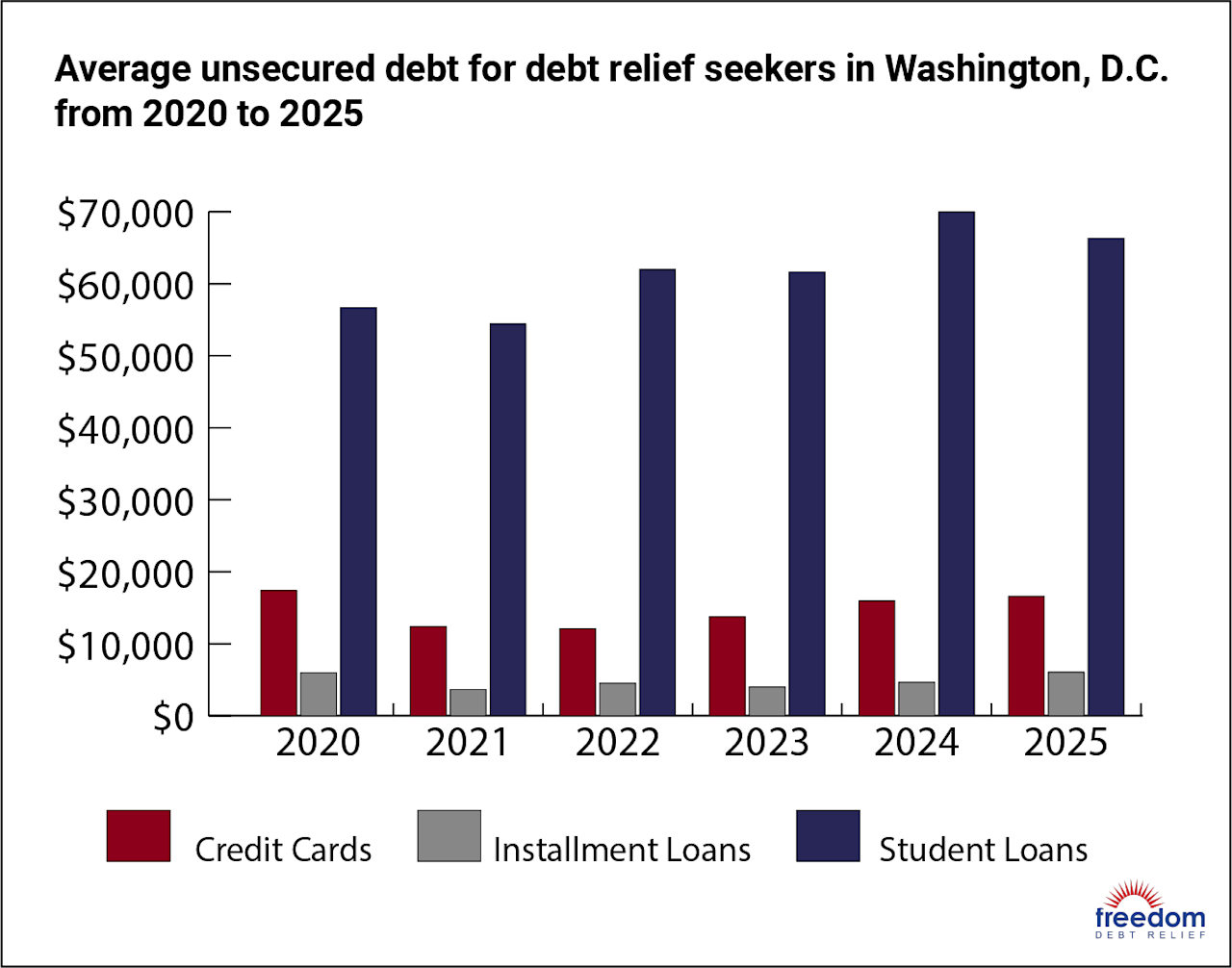
Age and credit both play a large part in typical debt balances. For Washington, D.C. debt relief seekers, unsecured debt peaked for those 36 to 50, with an average of $100,598 in 2024. Debt relief seekers with fair credit (580-669) and good credit (670-739) had the highest unsecured debt balances: $102,176 and $97,985, respectively, in 2024.
D.C. debt collection numbers are a mixed bag. Among debt relief seekers with debt in collections, the average number of collection accounts has been going down, from 2.4 in 2020 to 1.5 in 2024. That’s better than the national numbers (3.3 in 2020 to 2.0 in 2024).
But while the U.S. as a whole has seen collection balances and past-due amounts decline, they’ve been on the rise in the capital. The average collection balance was $4,655 in 2024 and $5,407 in the first half of 2025. That’s more than double the 2020 amount of $2,552.
Washington, D.C. credit card debt
Credit card debt is a serious issue in the nation’s capital. District of Columbia debt relief seekers had an average of $15,978 in credit card debt in 2024, above the national average of $15,636. Debt was spread across an average of 6.6 cards, with an average of $5,629 in past-due balances.
One of the challenges with credit card debt is that minimum payments are usually comparatively low. You could spend years or even decades holding credit card balances if you only pay the minimum. In D.C., the average monthly credit card payment in 2024 was $460.
Debt relief seekers also had a very high average credit utilization of 80.2%. That means their credit card balances totaled more than 80% of their credit limits. This kind of high utilization could be a sign of overwhelming debt. Look at Freedom Debt Relief's guide on how to get credit card debt relief if you’re experiencing this.
The oldest consumers are the deepest in credit card debt in D.C. Debt relief seekers 65 and older had the highest average credit card debt ($18,451), the most credit cards to manage (8.4), and the highest average past-due credit card debt ($7,167) in 2024.
Washington, D.C. auto loan debt
Debt relief seekers in Washington, D.C. had an average car payment of $661 on an average auto loan balance of $24,626 in 2024. Both amounts have risen moderately from the start of the decade. In 2020, the average payment was $544 and the average balance was $22,323.
Washington, D.C. mortgage debt
Washington, D.C. is an expensive place for home buyers. On average, debt relief seekers pay $2,436 a month and have an average balance of $347,601 on their home loans. Debt relief seekers across the U.S. pay an average $1,949 in monthly payments and have an average mortgage balance of $241,535. That’s more than $100,000 lower than in D.C.
Since 2020, most of the country has experienced rising housing costs. Washington, D.C. is no exception, but mortgage balances for debt relief seekers have gradually dropped since peaking at $365,190 in 2023. Over the first half of 2025, that number was down to $345,753.
Washington, D.C. installment loan debt
Installment loan debt is less of a concern in Washington, D.C. than in the rest of the country. The average D.C. debt relief seeker had $4,670 in installment loan debt in 2024, while debt relief seekers in the U.S. as a whole had a much larger $10,582. The average installment loan monthly payment in the nation’s capital is $285, lower than other types of debt.
However, this kind of debt spiked over the first half of 2025. The average balance rose to $6,073 in D.C. and $12,632 in the U.S. as a whole, a sign that those looking for debt relief could be taking out larger personal loans.
Washington, D.C. student loan debt
Higher education is another area where Washington, D.C. is more expensive, and that’s reflected in its student loan balances. Debt relief seekers here carried an average of $70,715 in student loan balances in 2024. Across the entire country, debt relief seekers had an average student loan balance of $49,861—still a sizable amount, but about $21,000 less.
Student loan debt has also been trending upward. In 2020, the D.C. average was $56,690. On a positive note, monthly payments are manageable. Debt relief seekers had to pay an average of $349 per month toward their student loan debt in 2024, and that number has stayed relatively stable over the last five years.
Washington, D.C. Debt Delinquencies and Collections
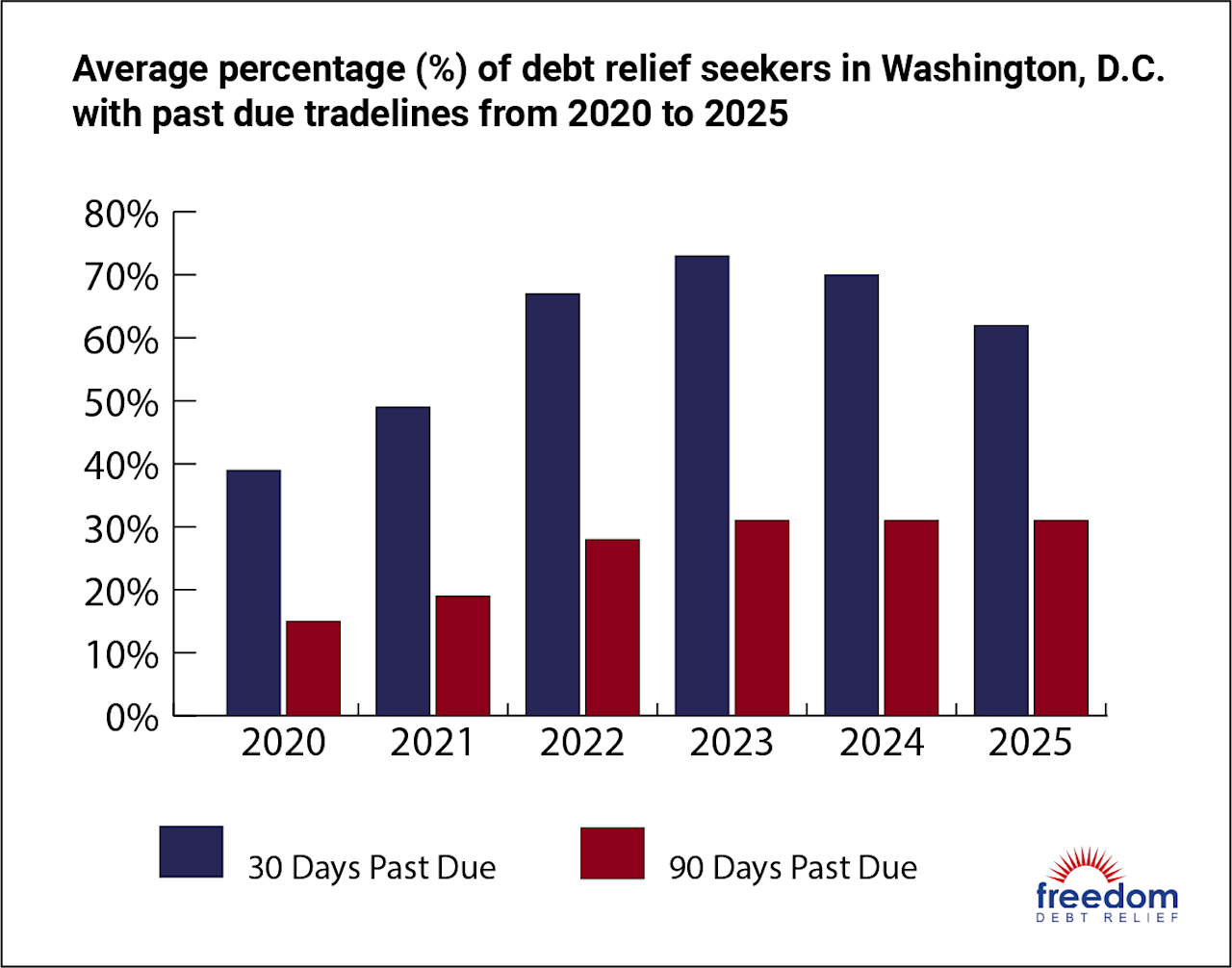
Debt delinquency rates in Washington, D.C. are above the national average for auto loans and bankcards (credit cards), according to TransUnion data from September 2025. Auto loans are where D.C. residents struggle the most, with 7.21% at least 30 days past due (DPD) compared to 4.34% nationwide. The D.C. mortgage delinquency rate is lower than the national average: 2.53% 30 days past due vs. 2.89% in the U.S.
Here’s a look at delinquency rates for auto loans, credit cards, and mortgages in D.C., with the percentage that are 30, 60, and 90 DPD.
| Type of debt | 30+ DPD | 60+ DPD | 90+ DPD |
|---|---|---|---|
| Auto loan | 7.21% | 3.08% | N/A |
| Credit card | 4.95% | 3.43% | 2.46% |
| Mortgage | 2.53% | 1.47% | 1.08% |
Many people looking into debt relief in Washington, D.C. already have accounts in collections, and the average balance has grown quite a bit. It soared from $2,552 in 2020 to $4,655 in 2024, and then up to $5,407 in the first half of 2025. The U.S. overall went in the opposite direction. Between 2020 and 2024, the average collections balance (for debt relief seekers with debt in collections) dipped from $3,815 to $3,183.
Washington, D.C. Statute of Limitations
The statute of limitations in Washington, D.C. is the length of time creditors and debt collectors have to sue you over a past-due debt. You’re not legally required to pay time-barred debt, meaning debt that is past the statute of limitations.
Statutes of limitations depend on the location and the type of debt contract you have. The D.C. statute of limitations is the same (three years) for all types of debt. Here are the types of debt and their Capital District statutes of limitations for easy reference.
| Type of debt contract | Washington, D.C. statute of limitations |
|---|---|
| Written contracts | 3 years |
| Oral contracts | 3 years |
| Promissory notes | 3 years |
| Open-ended accounts (such as credit cards) | 3 years |
What are the Washington, D.C. debt collection laws?
In 2022, Washington, D.C. passed the Protecting Consumers From Unjust Debt Collection Practices Amendment Act. This law provides several consumer protections against unfair and abusive debt collection practices, including:
A limit of four phone calls per account in any seven-day period
A limit of five emails, text messages, and private messages per account to a consumer in any seven-day period
A requirement that debt collectors submit supporting evidence before a court judgment can be entered in a lawsuit, even if the consumer fails to appear
A requirement that debt collectors inform consumers in writing that they may have funds that are protected from debt collection
Debt collectors in the U.S., including Washington, D.C., must also follow the Fair Debt Collection Practices Act (FDCPA).
Washington, D.C. Debt Relief
A debt relief program is a way to get rid of large, overwhelming amounts of unsecured debt. You make one low monthly deposit into a dedicated debt settlement account, and a debt relief company negotiates with your creditors on your behalf. Debt relief is most appropriate for consumers who aren’t able to keep up with their debt payments and can’t afford to fully repay their debts.
A debt relief program can take as little as 24 to 48 months and could help make debt more manageable. Since 2020, Freedom Debt Relief clients in Washington, D.C. enrolled an average of about $24,500 in debt.
If you’re looking for a Washington, D.C. debt relief program, call Freedom Debt Relief at 800-910-0065. A Debt Consultant will speak to you about your financial situation and goals, and then could come up with a debt relief plan that works with your income and expenses.
Is Debt Consolidation the Best Debt Solution?
Debt consolidation in Washington, D.C. could be the best solution if you want to reduce your monthly debt payments. This option usually works well for consumers with several credit cards and/or loans, because it simplifies the repayment process. After you consolidate debt, you’ll generally have far fewer monthly payments to manage.
You could also get a lower interest rate with debt consolidation, and possibly a lower total monthly payment, as well. Debt consolidation only works if you can keep up with your payments, and it doesn’t reduce the amount of debt you have. If you have too much debt to realistically pay back, then debt consolidation may not be the right solution for you.
The most effective debt solution depends on your situation. Here are a few other options to consider:
DIY debt payoff. You come up with your own debt repayment plan and follow it until your debt is paid off. Two popular strategies are the debt avalanche and the debt snowball. DIY debt payoff works well if your debt is manageable and you want to handle it on your own.
Debt settlement. You (or a debt relief company) negotiates settlements with creditors and debt collectors. If you’re deep in debt, debt settlement could help you get out.
Debt management plan (DMP). You work with a credit counseling agency that sets up a three- to five-year payment plan with your creditors. DMPs provide a structured approach to repaying debt, but the monthly payments can be high.
Bankruptcy. You file bankruptcy and must either liquidate assets or follow a three- to five-year payment plan, depending on whether you’re eligible for Chapter 7 or Chapter 13 bankruptcy. Once you complete the bankruptcy process, the court discharges any remaining eligible debts you have.
Washingtonians can free up cash each month with Freedom Debt Relief
Ozzy S., Freedom client²
“Right away, I had more money each month because of program costs so much less than what I was paying on my minimums.”
Excellent •
Is there really a debt relief program from the government?
Yes, but for credit card debt, the only government program would be bankruptcy, if you qualify. The government offers debt relief for certain types of debt, like student loan forgiveness programs and IRS tax debt settlement programs. However, the government doesn't have a general-purpose debt relief program that you can use with any type of debt.
Does unpaid debt ever go away?
Unpaid debt normally falls off your credit report after seven years. Chapter 7 bankruptcy is an exception, as it can stay on your credit history for 10 years. The amount of time you’re legally responsible for an unpaid debt varies, as it depends on the statute of limitations in your state. All states and Washington, D.C. have their own statutes of limitations.
Do you lose your credit cards after debt consolidation?
No, you don’t lose your credit cards after debt consolidation. When you consolidate credit card debt, you pay off your credit cards with a loan or a balance transfer card. Debt consolidation effectively brings the balances on your credit cards down to $0. You can then decide if you want to keep those cards or close them.
End Your Debt
Find out how our program could help.
- One low monthly program deposit

- Settlements for less than owed
- Debt could be resolved in 24-48 months