North Carolina Debt Relief: 5-Year Debt Trends
Household debt in North Carolina has been rock-steady for the past five years, according to Federal Reserve Bank of New York data. From 2020 to 2024, the average household in North Carolina had around $59,000 in total debt each year.
While steady is better than increasing, overall U.S. household debt has actually decreased by about $2,000 over the same time period. North Carolina residents are still doing better than average, however, owing around $2,800 less on average compared to U.S. households overall.
Despite owing less, more North Carolina residents are struggling with their debts.
TransUnion data from September 2025 shows 5.32% of residents were at least 30 days behind on their credit cards, 0.66% more than average for the country overall. And Freedom Debt Relief data estimates 70% of debt relief seekers from North Carolina were 30 days behind on at least one tradeline in the beginning of 2025.
North Carolinians can free up cash each month with Freedom Debt Relief

Ozzy S., Freedom client²
“Right away, I had more money each month because of program costs so much less than what I was paying on my minimums.”

Excellent •
5-Year Debt Trends in North Carolina
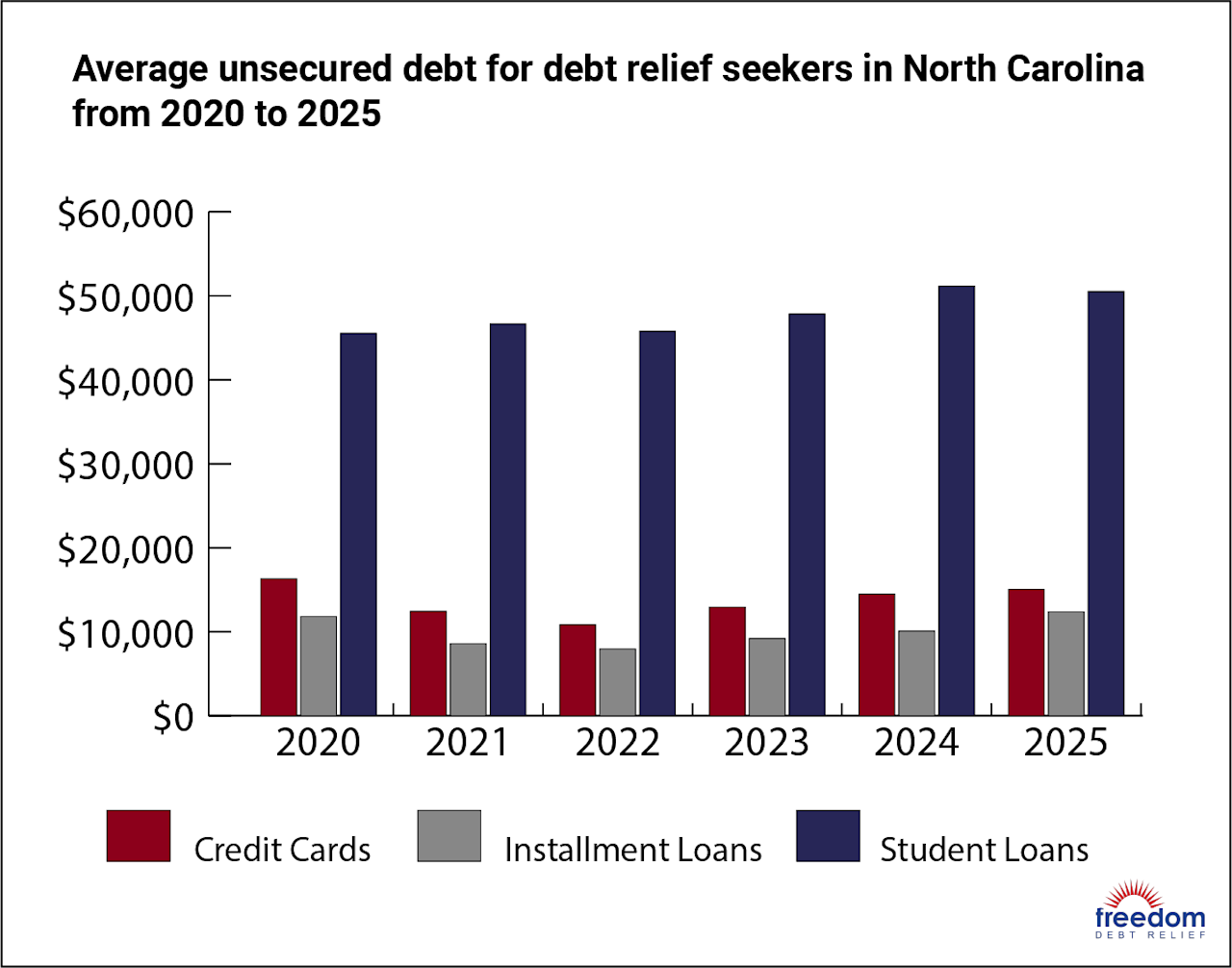
The last five years have been a mixed bag for debt relief seekers in North Carolina according to Freedom Debt Relief data. Average credit card debt is actually down about 8% from the 2020 high of $16,313, coming in at just over $15,000 for the beginning of 2025. However, that's still about 28% higher than the 2022 low of $10,854.
Most other types of debt have increased in the same time period. Unsecured debt—debt not backed by collateral, or something of value—is up for both installment loans and student loans. Amounts owed among debt relief seekers increased 4.5% for installment loans and 10% for student loans from 2020 to early 2025.
North Carolina debt relief seekers also owe more on their secured loans (loans backed by collateral) now than they did in 2020. Average auto loan debt rose 4.5% from 2020 to 2025 to $27,020.
Mortgage loan debt had the biggest jump, with the average debt relief seeker in North Carolina owing $207,659 in mortgage debt in early 2025. That's more than 21% higher than the $163,707 average owed by debt relief seekers in 2020.
North Carolina credit card debt
Credit cards are popular among North Carolina debt relief seekers, though the number per person—7.4 credit cards—is the same as the national average. North Carolina debt relief seekers have slightly lower balances on those cards, however, owing an average $15,050 in early 2025. That's about 7% less than the $16,244 average overall.
The slightly lower balances are reflected in the size of the monthly payments: $459 per month for debt relief seekers in North Carolina versus $489 for debt relief seekers overall.
Despite slightly lower monthly payments than average, many North Carolinians are still struggling with their credit card debt. The average credit utilization—how much of your credit limit you're using—is over 74% in the state, a big increase from the low of 65.7% in 2020.
Residents are also increasingly falling behind on that debt; in early 2025, debt relief seekers in North Carolina were past due on an average of $5,423 in credit card debt. That's less than the average U.S. debt relief seeker in 2025, but almost twice as much as the state's recent low of $2,827 in 2022.
North Carolina auto loan debt
Vehicle prices have gone up, up, up, and the numbers from North Carolina reflect this well. The average auto loan balance for debt relief seekers in the state rose more than 17% over the last five years from a low of $23,022 in 2020 to a high of $27,020 in early 2025.
While numbers have risen, North Carolinians's auto debt is pretty close to average. Both North Carolina debt seekers and those from the U.S. overall have an average of 1.5 auto loans each, and the total owed is only $23 more in North Carolina than the U.S. overall.
Despite slightly higher balances, North Carolina debt seekers are paying slightly less each month on their auto debt than the country overall: $722 a month in North Carolina versus $749 a month for the average U.S. debt relief seeker.
North Carolina mortgage debt
The median cost of a single-family home in North Carolina is estimated at around $403,700 for 2025. That's about 13% lower than the national average of $462,206. Interestingly, that ratio is the same for the mortgage debt owed by debt relief seekers in North Carolina versus the national average, as well.
North Carolina debt relief seekers owed an average of $207,659 in mortgage debt in early 2025, around 13% less than the $239,406 average owed by debt relief seekers nationally. The number of mortgage tradelines—1.2 per debt relief seeker—is the same for the state and the country overall.
Monthly mortgage payment numbers are slightly more divided, with North Carolina debt relief seekers paying an average $1,655 a month on mortgage debt. U.S. debt relief seekers overall pay around 17% more at $1,989 a month.
North Carolina installment loan debt
Installment loans seem to be growing in popularity for North Carolina residents struggling with debt. Debt relief seekers from the state have added installment tradelines to the tune of 2.6 a person on average. That's a big increase over the 2.1 loans-per-person debt relief seekers had in 2020, though still below the national average of 2.8 installment loans.
While the number of loans was a steady rise, balances have seen both ups and downs. In early 2025, the average North Carolina debt relief seeker owed $12,380 in installment debt, an increase of $556 over 2020 and more than $4,400 higher than the 2022 low.
These increases have led to an average monthly installment debt payment of $436 per North Carolina debt relief seeker in early 2025. While that's $59 higher than the 2020 average for the state, it's $49 lower than the average for U.S. debt relief seekers overall.
North Carolina student loan debt
Student loan debt for North Carolina debt relief seeks has been up and down over the last five years, though it hasn't dipped below the 2020 average low of $45,537. In early 2025, residents seeking debt relief owed an average of $50,527 in student loan debt, an increase of almost $5,000 over 2020.
That said, state averages are only slightly more than the average for U.S. debt relief seekers overall, coming in $595 higher than the $49,932 national average. Debt relief seekers in North Carolina also have a slightly larger number of loans at 5.3 on average per person versus 5 loans each for the U.S. overall.
Despite slightly higher student loan debt, monthly payments are actually slightly lower: $309 for North Carolina versus $313 for the U.S. overall. North Carolina debt relief seekers are still paying more each month than before, with that $309 monthly payment coming 25% more expensive than the 2020 average monthly payment of $234.
North Carolina Debt Delinquencies and Collections
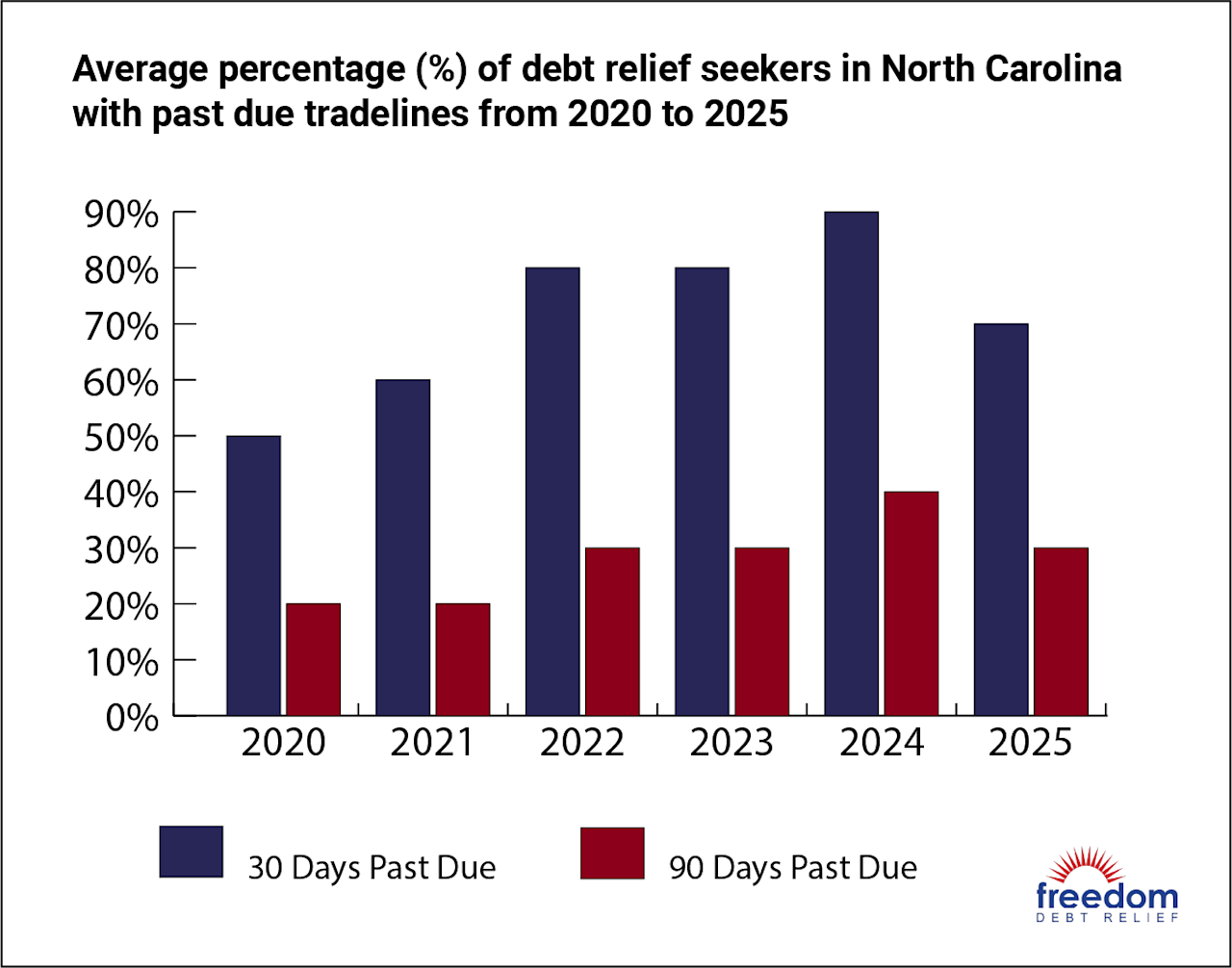
The last few years have been tough on many North Carolina residents in debt. Only about half of debt relief seekers in the state were 30 days or more past due on a loan or credit card in 2020; that number jumped to 70% in early 2025 after peaking at 90% in 2024. Those numbers are 10% higher than the national average for both 2024 and 2025.
The number of debt relief seekers with 90-day past-due accounts also grew in the same time period, jumping from 20% in 2020 to peak at 40% in 2024. Early 2025 data shows 30% of debt relief seekers in the state have accounts 90 days or more past due. That's on par with the national average.
Data about collections accounts shows a spot of hope for North Carolinians in debt. Both the number of accounts and amount of debt in collections have recently decreased. In early 2025, the average debt relief seeker in North Carolina had 1.9 accounts in collections totalling $2,732. In contrast, residents had an average of 3.7 tradelines in collections in 2020. They also owed about 14% more in 2020 with an average $3,163 debt collection balance.
This also puts North Carolina debt relief seekers in a slightly better position than the U.S. average. Nationally, debt relief seekers have an average collections balance of $3,040 across 1.9 loans or credit cards per person.
North Carolina Statute of Limitations
If you live in North Carolina, creditors and debt collectors typically have the right to sue you for past-due debt. They don't have forever, however. The time during which a debt collector can sue you for past-due debt is called the statute of limitations.
In North Carolina, the statute of limitations on most debt is three years. This applies to obligations that are part of written and oral contracts, including credit card or loan debt.
| Type of debt contract | North Carolina statute of limitations |
|---|---|
| Written contracts | 3 years |
| Oral contracts | 3 years |
| Credit card debt | 3 years |
| Personal loans | 3 years |
| Judgment | 10 years |
The main exception to the three-year North Carolina statute of limitations is for judgments. If there’s a judgment against you, the statute of limitations for that debt extends to 10 years.
What are the North Carolina debt collection laws?
State laws for debt collection are laid out in the North Carolina Debt Collection Act (NCDCA) and the North Carolina Collection Agency Act (NCCAA), many of which overlap with federal law.
Some notable protections for North Carolina residents include:
Debt collectors can't use threats of violence or profane language when contacting you. They also can't threaten arrest if you don't pay them.
Debt collectors can't pretend to be attorneys, government employees, or anything other than debt collectors trying to get you to pay a debt.
Debt collectors shouldn't contact you before 8:00 am or after 9:00 pm unless you give them permission.
Debt collectors aren't allowed to tell your employers or other third parties about your debts.
While they can't tell anyone else about your debt, debt collectors are allowed to contact other people in an attempt to reach you. They're also allowed to contact you in person, or by mail, telephone, or fax.
Reviews and Testimonials from North Carolina
Efficiency
Jacob Johnson, US
Very upfront with what they could do and so far everything has been going to plans.
Diana Howard, US
Keeps one.on track . Very informative.
Charles Glynn, US
North Carolina Debt Relief
Most North Carolina debt relief seekers are already behind on their debt payments. If that sounds like you, debt settlement could be the debt relief for you. Debt settlement involves negotiating with your creditors to settle your debt for less than the full amount of your balances. You can negotiate with creditors yourself, or let the experts at Freedom Debt Relief do it for you.
Picture this: You're a typical North Carolina debt relief seeker with $15,050 in credit card debt, likely an installment loan or two, and $1,483 in total monthly debt payments you can't make. Your credit cards are already at 74% capacity and your FICO Score has dropped to 587. You have $2,732 of debt in collections and you're at your wit's end.
Thousands of North Carolina debt relief seekers were in your position in 2020. They joined the Freedom Debt Relief program, enrolling an average of $26,741 in debt per client.
Not sure if debt settlement is the right solution for you? Contact Freedom Debt Relief to speak with a debt expert about your options.
Is Debt Consolidation the Best Debt Solution?
If you're still up to date on your debt payments, consolidation could be a good solution for getting a handle on your debt. In the best case, consolidating your debt can simplify your finances and reduce your interest rate.
Consolidation is when you use a new loan to pay off multiple existing debts. When you qualify, a lower rate on your consolidation loan could give you a lower monthly debt payment.
If you can't get a lower rate, consolidation may not be the best strategy. Here are some other alternatives:
DIY debt payoff: If you can afford your debt but need some organization, try the debt snowball or debt avalanche methods. You can prioritize your debts and work on paying them off on your own.
Debt settlement: If you're already behind, your creditors may negotiate to settle your debt for less than you owe.
Debt management plan (DMP): This is a structured repayment plan for paying off your debt in three to five years set up by a credit counseling agency. DMPs work best if you can afford your debt and just need guidance.
Bankruptcy: If you qualify, Chapter 7 bankruptcy could be a way to get rid of unsecured debt without paying. Chapter 13 bankruptcy may be a better choice if you're trying to save assets like a home.
North Carolinians can free up cash each month with Freedom Debt Relief
Ozzy S., Freedom client²
“Right away, I had more money each month because of program costs so much less than what I was paying on my minimums.”
Excellent •
What are the main debt consolidation methods available in North Carolina?
Residents of North Carolina can consolidate debt using one of three methods:
Personal consolidation loan. This could be a good choice because personal loans are unsecured, meaning they don't require collateral or something of value that backs it up. Personal loans tend to have lower rates than credit cards. Your rate will depend largely on your credit history.
Home equity loan or home equity line of credit (HELOC). If you own your home and it's worth more than you owe, you have home equity. You can apply to use that equity as collateral for a home equity loan or line or credit to consolidate debt. The upside is generally lower interest rates. The downside is your home could be at risk if you can't repay the loan.
Balance transfer credit card. If you can qualify for 0% APR offer, using a balance transfer credit card to consolidate high-interest debt could be a good move. These offers typically require good credit.
What are eligibility requirements for a debt consolidation loan in North Carolina as of late 2025?
The qualifications you need for a consolidation loan in North Carolina will depend on the lender, the loan type, and the amount you need to borrow. In general:
Personal consolidation loans require good credit and reliable income. A credit score of 660+ is recommended. Your interest rate and loan size will depend on your credit history and debt-to-income (DTI) ratio. To find out your DTI, divide your total monthly debt payment by your gross (pre-tax) monthly income. Lenders want to know you can afford to repay your loan.
Home equity loans require fair credit and more than 20% in home equity. Secured loans often have more flexible credit requirements than unsecured loans, so you could apply for a home equity loan with a credit score in the 600+ range. Your loan size will depend on how much home equity you have and your financial situation.
How can you find the best debt consolidation companies and non-profits in North Carolina?
A few good ways to look for a debt consolidation company in North Carolina are:
Ask your friends and family for recommendations. It can be reassuring to know that someone else had a great experience with a company before you do business.
Chat with your current bank. If you're happy with your bank, check if they offer consolidation loans with competitive rates and fees.
Check local credit unions. You can often get good rates from credit unions, and they might have more flexible credit requirements than big banks.
Use an online search engine. Online lenders can have competitive rates and could be a convenient option. You can also use the search engine to look up the lender's reviews and research their reputation online.
Are there specific North Carolina laws affecting debt consolidation programs?
Yes. North Carolina has several laws that may protect you when you get a debt consolidation loan. The state’s Office of the Commissioner of Banks regulates loan companies, and the Consumer Finance Act (CFA) covers many unsecured personal installment loans less than $25,000.
Some relevant laws include:
Lenders must be licensed in the state.
Borrowers can pay back their loan in full at any time without an extra fee or penalty.
In general, loan interest rates in North Carolina are capped at the federal discount rate plus 5%. However, CFA loans may have higher interest rates, with some loans under $4,000 allowed to charge up to 33% interest.
CFA loans should have a repayment term between 12 and 96 months.
Lenders that operate in multiple states may be subject to federal or other state laws rather than North Carolina interest caps and loan rules.
What are typical interest rates for debt consolidation loans in North Carolina in late 2025?
The average interest rate on a two-year personal loan was 11.14% in October 2025, according to the Federal Reserve Bank of St. Louis. The interest rate you get on a loan in North Carolina will depend primarily on your credit history. In general, personal loan interest rates can range from 6% to 36%, with the lowest rates going to the borrowers with the highest credit scores.
You can improve your chances of getting a low interest rate by making sure your credit history is looking its best. Payment history is the biggest credit score factor, so make your bill and debt payments on time. Better yet, pay a few days early every month. You could also improve your credit score by paying down credit card debt if you have high balances.
How does debt consolidation affect credit scores in North Carolina?
Consolidation could both help and hurt your credit score, depending on how you consolidate and your current scores. Here are some potential impacts to consider:
Hard credit inquiry. When you apply for new credit, the lender checks your credit report. This leaves a hard inquiry on your report for up to two years. One or two generally won't hurt your score too much, but several hard inquiries in a short period of time could have a larger impact on your score.
Lowered account age. Credit scores look at the age of your credit accounts, and older accounts raise your score. A new consolidation loan could lower your average account age and ding your credit score.
Reduced utilization rate. Your score considers how much of your revolving credit, or credit card limits, you use. A high utilization could damage your credit scores. When you consolidate credit card debt with a personal or home equity loan, it could lower your utilization and potentially help your score.
What are the pros and cons of debt management plans versus personal loans for consolidation in North Carolina?
A debt management plan (DMP) is a structured debt repayment plan you could enter into with a credit counseling agency. The credit counselor may negotiate with your creditors to get a lower interest rate or fee waivers, but you’ll fully repay your debts and you won't need a new loan. Most DMPs require you to close your credit card accounts, and they can take three to five years to finish.
A personal debt consolidation loan is a new loan you take out to pay off multiple existing debts. It works best if you can get a lower interest rate than you're currently paying, which may require good credit. A lower interest rate on a consolidation loan could both simplify your finances and lower your monthly debt payments. You can consolidate with a loan on your own.
Here are some notable pros and cons:
| Pros | Cons | |
|---|---|---|
| Debt management plan (DMP) | May include interest rate or fee reduction; often includes financial counseling | Requires a credit counseling agency; takes three to five years to pay off |
| Personal consolidation loan | Could lower your monthly payment; can be done on your own | Your rate will depend on your credit; a new loan could temporarily hurt your credit |
Are there government-backed debt relief programs available to North Carolina residents?
Yes, for medical debt. North Carolina's Medical Debt Relief Program encourages hospitals to forgive medical debt for eligible state residents. People eligible for medical debt forgiveness include:
Medicaid enrollees
Residents with incomes at or below 350% of the Federal Poverty Level (FPL)
Residents with medical debt that exceeds 5% of income
Eligibility has a few exceptions, and the program only extends to participating hospitals.
North Carolina doesn’t have any government-backed programs for credit card or personal loan debt relief. The only state-involved debt relief for unsecured debt is to file for bankruptcy. Chapter 7 bankruptcy could help you walk away from all or most of your unsecured debt if you qualify.
If you're struggling with debt in North Carolina, your local government may offer additional resources. You can also reach out to community nonprofits or your local credit union for financial resources and education.
How can you choose a reputable debt consolidation service in North Carolina?
Research is the key to finding a reputable debt consolidation lender or program in North Carolina. Here are some factors to consider:
Costs and fees. The company's fees should be clearly laid out and competitive. Look at all of the costs for your loan or program, including interest rates and the total cost, not just the monthly payment.
Reviews and customer service ratings. Ask friends and family or use online review sites like TrustPilot to learn what people are saying about the company. Are people generally happy with the service—or are there red flags?
Communication. You want a lender or program that will be there when and how you need them, whether that's online chats or 24/7 phone availability. Checking BBB.org can tell you if the company responds when customers have problems or questions.
Convenience and access. You could be dealing with your debt consolidation lender or program for years to come, so it should be convenient to do so. A good mobile app that lets you monitor and pay your loan could help you stay on track.
Can you consolidate student loan debt with other debts in North Carolina?
Technically, yes, North Carolina residents could consolidate student loans with other types of debt if they qualify for a loan that’s large enough. A personal loan may be difficult to obtain if you need a large amount, so you might need to turn to a home equity loan. These loans are backed by your property, which could put it at risk if you can't repay the loan.
It's possible to consolidate student loans along with other debt, but it's usually a bad idea. Consolidating federal student loans through a private lender typically means giving up many important protections, including access to income-driven repayment and government loan forgiveness programs. If you want to consolidate multiple federal student loans, consider doing it with a federal direct consolidation loan.
End Your Debt
Find out how our program could help.
- One low monthly program deposit

- Settlements for less than owed
- Debt could be resolved in 24-48 months