

New Jersey Debt Relief by the Numbers: 5-Year Debt Trends
New Jersey is one of the most expensive states in the country. The Garden State ranks Number 3 for highest cost of living, after California and the District of Columbia. New Jersey’s high cost of living could be a big reason why state residents have higher debt than the average American. Recent survey data from the Federal Reserve Bank of New York shows that the average New Jersey resident had $68,400 of debt in 2024. That’s $6,800 more than the average American.
With life in New Jersey feeling unaffordable for so many people, it’s no wonder that some New Jersey residents are falling behind on bills and looking for New Jersey debt relief. Between 2021 and 2025, Freedom Debt Relief heard from thousands of people looking for debt relief in New Jersey. Freedom Debt Relief’s data about New Jersey debt relief seekers shows that, among this group of people, the average person’s total debt went from $354,775 in 2021 to $388,893 in 2025. That’s an increase of almost 9.6% over four years. This is actually far below the U.S. national average debt increase of 23.4% during that time.
New Jersey debt relief seekers experienced a big decrease in credit scores during the past few years. In 2020, the average person looking for debt relief in New Jersey had a FICO Score of 667. By 2024, that average New Jersey credit score had dropped to 590. The U.S. national average credit score for debt relief seekers nationwide is 715.
New Jerseyan can free up cash each month with Freedom Debt Relief

Ozzy S., Freedom client²
“Right away, I had more money each month because of program costs so much less than what I was paying on my minimums.”

Excellent •
5-Year Debt Trends in New Jersey
Even though the average increase in total debt for New Jersey debt relief seekers (9.6%) was lower than the average of U.S. debt relief seekers, Freedom Debt Relief data shows that people in New Jersey are still struggling with a few unique debt challenges.
Here are a few of the biggest five-year debt trends in New Jersey that stand out from Freedom Debt Relief’s data:
Higher incomes. People in New Jersey looking for debt relief earn more money than the average of those seeking debt relief throughout the U.S. As of 2025, New Jersey debt relief seekers had an average income of $78,085, up from $74,088 in 2021—an increase of about 5.4%.
Lower credit utilization. New Jersey debt relief seekers use less of their available credit than people looking for debt relief nationwide. In 2024, people in New Jersey looking for credit relief used 72.5% of their available credit, while the average credit utilization for debt relief seekers nationwide was 75.7%.
Bigger mortgage debts. New Jersey’s high cost of housing shows up in people’s mortgage balances. People seeking debt relief in New Jersey had an average mortgage balance of $285,360 in 2024, an increase of 31.8% over 2020. The national average debt relief seeker’s mortgage balance was $241,535 in 2024, a 22.7% increase from 2020.
New Jersey credit card debt
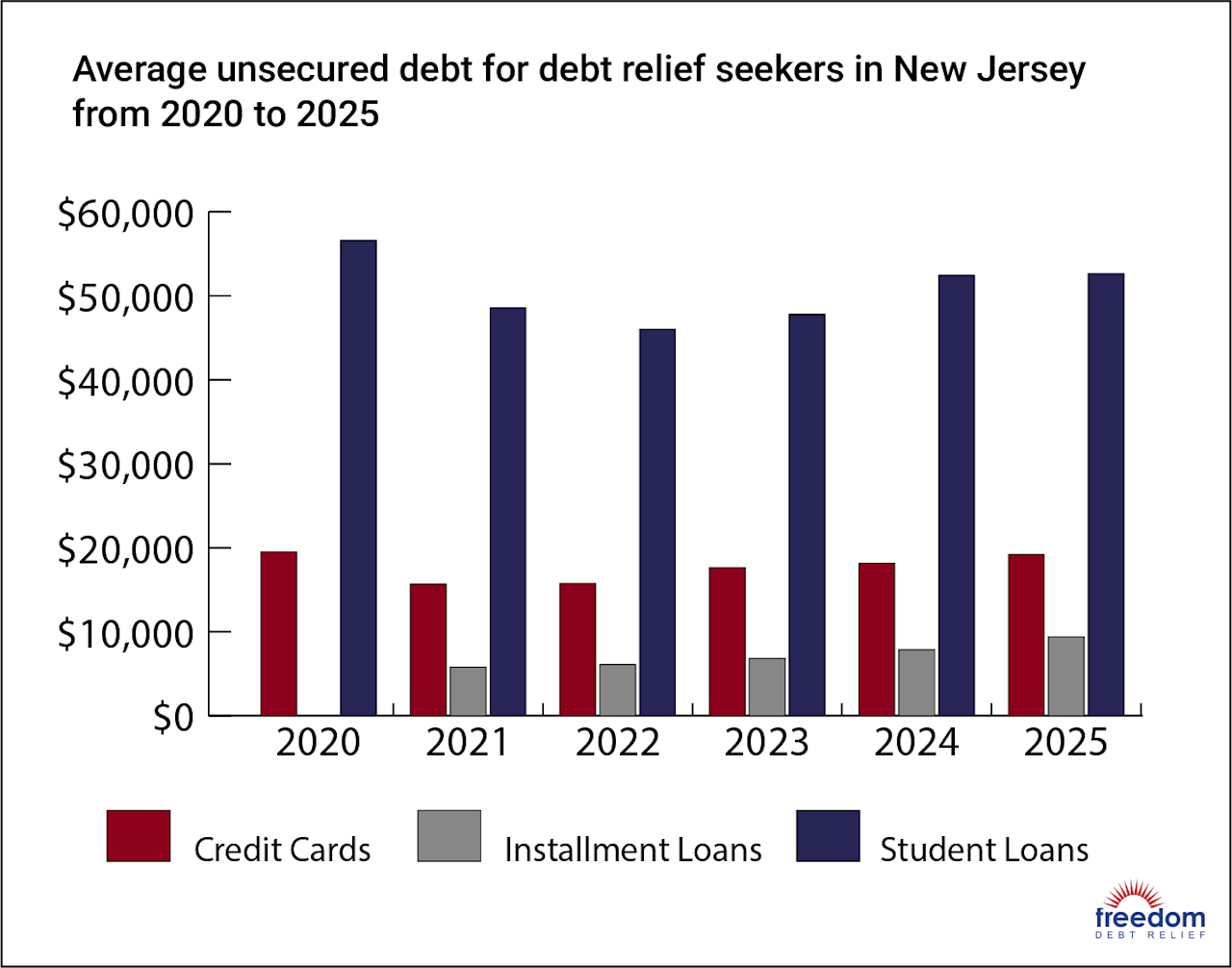
People seeking debt relief in New Jersey aren’t just facing higher mortgage balances, they also tend to have more credit card debt than people looking for debt relief nationwide. New Jersey debt relief seekers had an average credit card balance of $19,219 in 2025, up from $15,676 in 2021. That’s an increase of 22.6% in the average card balance.
The average credit card payment for New Jersey debt relief seekers was $560 in 2025, higher than the average of $489 for U.S. citizens looking for debt relief. Although debt relief seekers in New Jersey have higher amounts of credit card debt, their balances grew more slowly than for people seeking debt relief nationwide. The average credit card balance for debt relief seeker nationwide increased by 28.4%.
New Jersey debt relief seekers also use slightly less of their available credit than U.S. seekers of debt relief nationwide. In 2024, people looking for debt relief in New Jersey were using 72.5% of their available credit limits, which is lower than the national average debt relief seeker’s credit utilization of 75.7%.
Since New Jersey debt relief seekers have higher incomes than people looking for debt relief in the rest of the country, it makes sense that they might qualify for higher credit limits. But 72.5% for credit utilization is still a sign of financial trouble. This means you’re using $7,250 out of a $10,000 credit line. Even if you used to have a great credit score and a higher-than-average income, you still might experience financial hardship that can leave you needing credit card debt relief.
New Jersey auto loan debt
Many New Jersey living expenses are higher than the national average. But auto loans might be less of a burden for New Jersey debt relief seekers. One surprising debt trend from Freedom Debt Relief’s data is that New Jersey debt relief seekers have lower auto loan balances than people looking for debt relief in the rest of the country.
As of 2025, the average New Jersey resident looking for debt relief had an auto loan balance of $23,489. That’s lower than the national average auto loan balance of $26,997 for debt relief seekers in the U.S. New Jersey’s average auto loan payment was lower, too: $708 per month, versus $749 for seekers of debt relief nationwide.
And New Jersey debt relief seekers have had a lower rate of increase in their auto loan balances during the past few years. The average auto loan balance for New Jersey residents looking for debt relief went up by 8.5% between 2021 and 2025, far lower than the average auto loan balance increase of 17.3% for debt relief seekers nationwide.
New Jersey mortgage debt
When it comes to mortgage debt, New Jersey debt relief seekers stand out from the average seeker of debt relief in the U.S. New Jersey’s high housing costs bring higher-than-average mortgage balances. In 2024, the average person in New Jersey looking for debt relief had a mortgage balance of $285,360 and an average monthly payment of $2,589. Both these averages are higher than they are for debt relief seekers nationwide. In 2024, the average person seeking debt relief in the U.S. had a mortgage balance of $241,535 and a monthly mortgage payment of $1,949.
New Jersey debt relief seekers have also experienced more rapid increases in the size of their mortgage balances. The national average debt relief seeker’s mortgage balance increased by 23% during 2020 to 2024 (from $196,780 to $241,535). But in New Jersey, the increase in mortgage balances was even bigger. During those years, the average New Jersey debt relief seeker’s mortgage balance went up by 31.8% (from $216,543 in 2020).
New Jersey installment loan debt
New Jersey residents seeking debt relief have smaller amounts of installment loan debt than the national average seeker of debt relief. While the U.S. national average installment loan balance for debt relief seekers was $12,632 in 2025, New Jersey debt relief seekers had an average installment loan balance of only $9,413. However, the average installment loan monthly payment in New Jersey was $495, a bit higher than the average of $485 for U.S. citizens seeking debt relief.
One place that New Jersey stands out from the national average is in the growth of its installment loan balances. From 2021 to 2025, New Jersey debt relief seekers had an increase of 62% in their average installment loan balance, while the national average debt relief seeker’s installment loan balance went up by 47%. This could be a sign that New Jersey debt relief seekers are using a wider variety of personal loans to make ends meet.
New Jersey student loan debt
As of 2025, the average student loan balance for New Jersey debt relief seekers was $52,645, with an average monthly student loan payment of $353. That’s 5.4% higher than the national average of $49,932 for debt relief seekers. And New Jersey debt relief seekers have higher monthly student loan payments along with their higher balances. The monthly average New Jersey student loan payment was 12.8% above the national average payment of $313.
Student loan balances for people seeking debt relief in New Jersey are growing more slowly than the national average. The U.S. national average debt relief seeker had a student loan balance of $49,932 in 2025 compared to $43,622 in 2021—a 14.5% increase. The average student loan balance for New Jersey debt relief seekers only went up by $4,082—8.4%, over the last four years.
New Jersey Debt Delinquencies and Collections
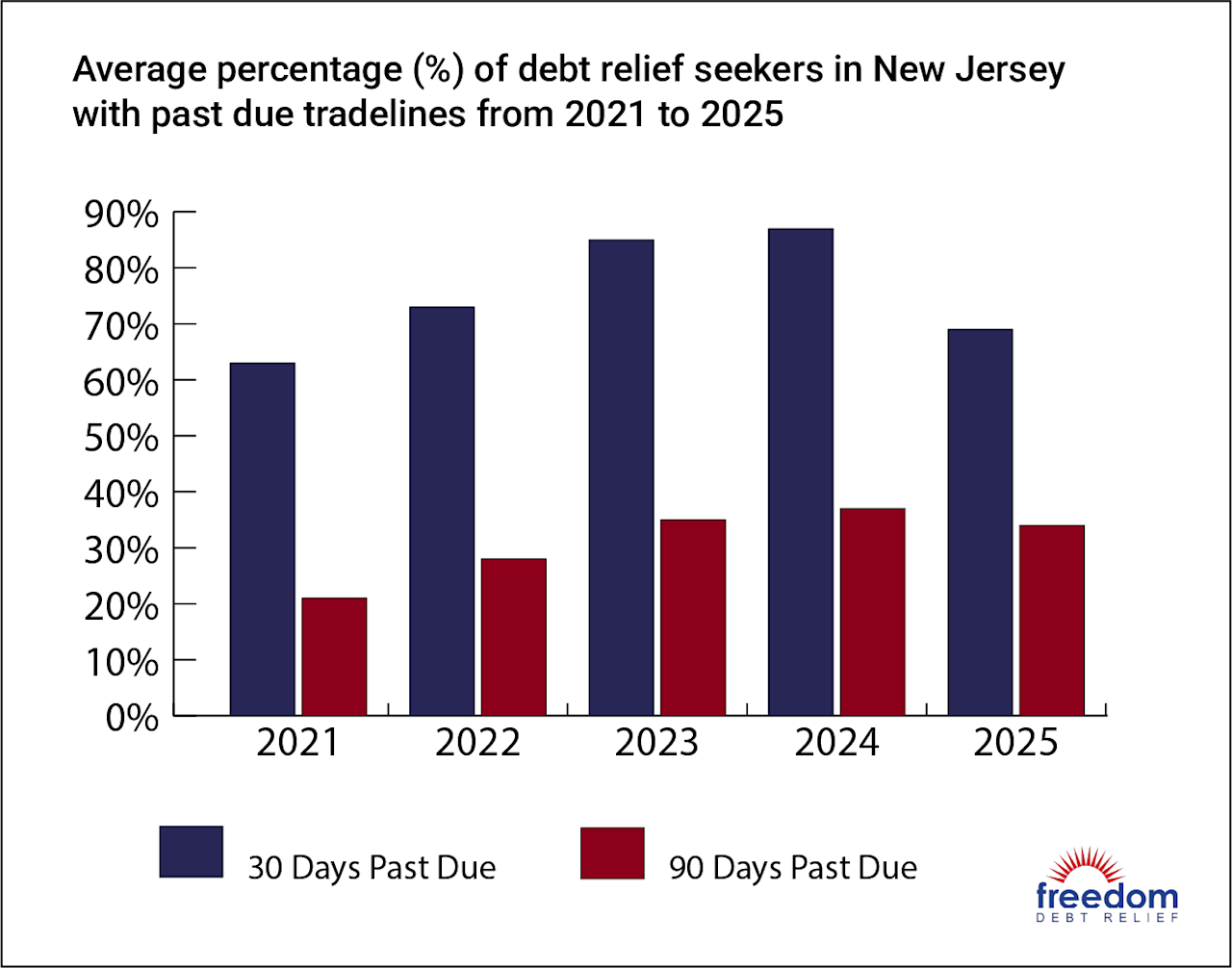
New Jersey residents are less likely than the national average to become delinquent on auto loans and credit cards, but more likely to fall behind on their mortgage payments. TransUnion data from September 2025 shows how New Jersey debt delinquency rates stack against U.S. national averages.
Garden State residents have lower rates of auto loan delinquency than U.S. national averages for seekers of debt relief. Only 3.95% of New Jersey auto loan borrowers were at least 30 days past due (DPD), compared to 4.34% nationwide.
New Jersey credit card customers are also more likely than the national average to be up to date on their card payments. Only 4.45% of New Jersey consumers are at least 30 days past due on their credit cards, compared to 4.66% of credit card borrowers nationwide.
However, New Jersey homeowners are slightly more likely than the national average to become delinquent on their mortgages. Among New Jersey homeowners, 3.01% are at least 30 days past due on their mortgage, compared to only 2.89% for the entire U.S.
Here’s a look at New Jersey debt delinquency rates for auto loans, credit cards, and mortgages, with the percentage that are 30, 60, and 90 days past due.
| Type of debt | 30+ DPD | 60+ DPD | 90+ DPD |
|---|---|---|---|
| Auto loan | 3.95% | 1.47% | N/A |
| Credit card | 4.45% | 3.08% | 2.21% |
| Mortgage | 3.01% | 1.42% | 0.90% |
New Jersey debt relief seekers who fall behind on their bills tend to have lower, and fewer, collection accounts than the national average. In 2024, people in New Jersey looking for debt relief had an average collection balance of $2,694, while the national average was $3,183. New Jersey debt relief seekers also had fewer accounts in collections (an average of 1.6 accounts) compared to the national average of 2.0 accounts in collections.
New Jersey Statute of Limitations
The New Jersey statute of limitations defines how long creditors and debt collectors can sue you for overdue debts. Debts that are outside the statute of limitations are time-barred. When a debt becomes time-barred, creditors and debt collectors can no longer sue you. The New Jersey statute of limitations for debt helps protect your rights and can help you defend yourself against debt lawsuits.
Generally, the statute of limitations on debt in New Jersey is six years:
| Type of debt contract | New Jersey statute of limitations |
|---|---|
| Credit Cards | 6 years |
| Personal Loans | 6 years |
| Auto Loans | 6 years |
| Mortgages | 6 years |
If your debt is older than six years, New Jersey debt collectors don’t have the right to sue you for it. If they do, don’t ignore the lawsuit. You still need to answer the lawsuit, but you could use the New Jersey statute of limitations to defend yourself against the lawsuit and try to get the case dismissed. In New Jersey, if a creditor wins a court judgment against you, the time limit to collect on that judgment is 20 years.
Depending on your situation, you might want to talk with a New Jersey attorney who helps with debt cases.
What are the New Jersey debt collection laws?
New Jersey does not have any state-specific laws about debt collection. But if you have overdue debt in New Jersey, you’re protected by the federal debt collection law, the Fair Debt Collection Practices Act (FDCPA).
The FDCPA lays out clear rules to protect your rights. It puts limits on how debt collectors (including debt buyers, collection agencies, and attorneys) are allowed to contact you and conduct business with you.
Under FDCPA rules, debt collectors can’t:
Harass you, use obscene or profane language, or threaten you with violence
Contact you without telling you their name and identifying themselves as a debt collector
Contact you at inconvenient times, such as before 8 a.m. or after 9 p.m.
Talk about your debt with your employer, friends or family
Threaten to sue you if they don’t have the right to sue you or don’t actually intend to sue
If you believe that a debt collector has violated your rights under the FDCPA, you can sue them for damages.
New Jersey Debt Relief
If you’re behind on bills, getting calls from debt collectors, or experiencing another financial hardship, looking for debt relief in New Jersey can be a good choice.
Check out some of the resources for New Jersey residents in need of debt relief. Residents facing hardship or in need of assistance can explore several programs.
The Foreclosure Mediation Assistance Program (FMAP). For homeowners who may need counseling to help prevent possible foreclosure. Services are available at no cost.
Emergency Rescue Mortgage Assistance (ERMA). This program provides up to $75,000 per household for COVID-19 related hardships to cover mortgage payments, tax delinquencies, and housing-related costs. Applications are still being accepted.
NJ 211. Residents can call 2-1-1 or visit the website for a directory of local, state, and non-profit assistance programs.
Low Income Home Energy Assistance Program (LIHEAP). Helps with heating and cooling bills.
You could also try negotiating with your creditors. Sometimes creditors are willing to take less than the full amount you owe and forgive the rest if they believe it’s their best hope of getting anything at all. Settling a debt could be less costly than going to court, and creditors know that there’s no guarantee that they’d win a lawsuit against you.
Debt negotiation works best for people who have experienced serious financial hardship like medical emergencies, long-term unemployment, or other severe setbacks and can’t realistically afford to fully repay their debts.
If you’re looking for New Jersey debt relief and want to learn more, call Freedom Debt Relief at 800-910-0065. A Debt Consultant will talk with you about your overall debt situation and financial goals. Freedom Debt Relief could help you find a New Jersey program that might help you get rid of your debt.
Is Debt Consolidation the Best Debt Solution?
If you’re looking for debt relief in New Jersey, note that different debt solutions are appropriate for different situations. Debt consolidation loans could be a good choice for people who can qualify for a lower-interest loan and who have steady income to pay off debt.
If you’re struggling with high-interest credit card debt, falling behind on bills, or getting calls from debt collectors, you might want to think about debt relief instead of debt consolidation. Not everyone’s situation is the right fit for a debt consolidation program. Some people might be better off with other debt solutions.
Here are a few debt solutions that might help you get rid of debt, depending on your financial situation.
Debt consolidation
With debt consolidation, you take out a new loan at a potentially lower interest rate and use it to pay off multiple other loans all at once. Debt consolidation loans don’t immediately clear your debt. But they could lower your monthly payment, reduce your interest rate, cut down on the total amount of interest that you pay, and simplify your life with one payment instead of several debt payments.
If you’re juggling several credit card balances at once, and if you have a good enough credit score to qualify for a lower-interest loan, debt consolidation could be a good choice. For example, in 2024, people seeking debt relief in New Jersey had an average of 8.7 credit cards open. If you’re struggling to make payments across several cards, a debt consolidation loan could make your financial life easier.
Some of the best choices for debt consolidation loans include a home equity loan, a personal loan, or a balance transfer credit card with a low introductory APR.
DIY debt payoff
Sometimes the best way to get rid of debt is just by paying it off yourself. The DIY debt payoff strategy includes different methods. Choose a debt payoff plan that fits your budget and suits your personality.
Some people love the debt snowball method, where you start by paying off your smallest debt first, even if it’s a lower-interest debt. This early win could help you build momentum and feel more empowered to tackle the rest of your debt.
In the debt avalanche, you start with the highest-interest debt. This way, you have the opportunity to save money on interest in the long run.
You don’t need a debt consolidation loan for a DIY debt payoff. You just need a steady income, a clear budget, and strong determination to get rid of debt, even if that means making sacrifices.
Debt settlement
Sometimes, a person has so much debt they have no realistic way to pay it off. Being in debt doesn’t mean you made bad choices or were irresponsible. Many people have credit card debt and other personal debts because of bad luck in the job market, unforeseen medical expenses, death, divorce, or some other life event.
Debt settlement might be a good debt solution if you:
Struggle to pay your credit cards
Are behind on bills
Already have accounts in collections
Get calls from debt collectors
With debt settlement, your creditors agree to accept less than you owe on the debt. This debt solution can only be used for unsecured debts, such as credit cards, store cards, and medical bills.
Debt settlement typically causes credit score damage. Forgiven debt could be taxable. There are no guarantees that creditors will accept a debt settlement offer. Legitimate debt relief providers will explain how their program works in a clear, understandable way—including any potential risks and downsides.
Debt management plan (DMP)
If you’re struggling with credit card debt and don’t want to attempt settlement, you might consider a debt management plan (DMP). Credit counseling agencies offer this solution.
With a DMP, you work with a credit counseling agency to consolidate your credit card debts and set up a customized payment plan designed to fully repay your unsecured debts in three to five years. You make one payment to the credit counseling agency, and they distribute the money to your creditors.
A DMP could be a good choice in some situations. If you struggle to make the monthly payment, your DMP might fail to solve your debt problem.
Bankruptcy
Filing bankruptcy could be the best choice for some New Jersey seekers of debt relief. If you have no reasonable way to pay off credit card and other debts, bankruptcy could help, depending on your situation.
Bankruptcy doesn’t automatically wipe out all types of debt. Depending on the kind of bankruptcy you file, you might have to give up some of your property or all of your disposable income for several years. Bankruptcy is a serious negative event on your credit history that stays on your credit report for seven to 10 years. It may be the best choice for people with the most serious debt problems.
Talk to a bankruptcy attorney if you think bankruptcy might be a good choice for you. It’s possible to rebuild your credit after bankruptcy. Sometimes seeking the legal protection of bankruptcy can be the best way to get past your debt and move forward in life.
New Jerseyan can free up cash each month with Freedom Debt Relief
Ozzy S., Freedom client²
“Right away, I had more money each month because of program costs so much less than what I was paying on my minimums.”
Excellent •
Is Freedom Debt relief a legit company for New Jersey debt relief?
Freedom Debt Relief is a legitimate professional debt relief company. Its New Jersey partner offers debt settlement programs that could help you get rid of debt by negotiating with creditors on your behalf.
What is the debt collection law in New Jersey?
People in New Jersey are covered by the federal law, the Fair Debt Collection Practices Act (FDCPA). This federal law puts limits on how debt collectors can contact you and how they can behave toward you. Even if you’re overdue on debts, you still have rights and deserve to be treated fairly and respectfully.
How much will New Jersey debt relief hurt my credit?
Debt settlement and bankruptcy will both appear as negative marks on your credit report and will almost certainly lower your credit score. How much depends on your starting score. If you're already missing payments, then debt settlement may not hurt much more. If you have a perfect history of on-time payments, then stopping payments, settling your debts, or filing for bankruptcy will likely cause your credit score to drop sharply. Once your debts are behind you and your finances are stable, you’ll be in a better position to build and maintain good credit going forward.
Debt management plans typically cause initial credit score damage that could resolve when you complete your plan.
DIY debt payoff plans are often a great way to build good credit over time if you’re paying on time every month and steadily lowering your credit card balances.
Debt consolidation could cause a small dip in your credit score when you apply for the new loan, but getting rid of your credit card debt could have a positive impact on your credit standing.
End Your Debt
Find out how our program could help.
- One low monthly program deposit

- Settlements for less than owed
- Debt could be resolved in 24-48 months
