



New Hampshire Debt Relief by the Numbers: 5-Year Debt Trends
New Hampshire residents have debt; $65,540 of it on average, to be exact. That's according to the Center for Microeconomic Data, which tracks mortgage, student loan, credit card, and auto loan debt by state. On average, the typical American owes slightly less, at $63,340. If you look only at people who seek debt relief in the Granite State, the estimated debt is $33,474.
Here's a snapshot of how residents manage their debt.
The average FICO Score is 608, and residents use 70% of their available credit card limit.
The typical household income among debt relief seekers is $75,442 and approximately 41% of that goes to debt repayment each month.
On average, the minimum monthly debt payment is $2,106, higher than the $1,799 people on average nationwide.
Statewide, 16% of residents seeking help with debt have at least one debt in collections, compared to 23% for U.S. residents looking for debt relief.
If any of this sounds familiar to you, New Hampshire debt relief could offer a way out. You could reduce what you owe and get rid of credit cards and other debts in less time. Let's take a closer look at how debt trends have shifted in the state over the last five years.
Freedom Debt Relief does not provide debt settlement services for people in New Hampshire. They may be referred to a third party provider or law firm.
New Hampshirites can free up cash each month with Freedom Debt Relief

Ozzy S., Freedom client²
“Right away, I had more money each month because of program costs so much less than what I was paying on my minimums.”


5-Year Debt Trends in New Hampshire
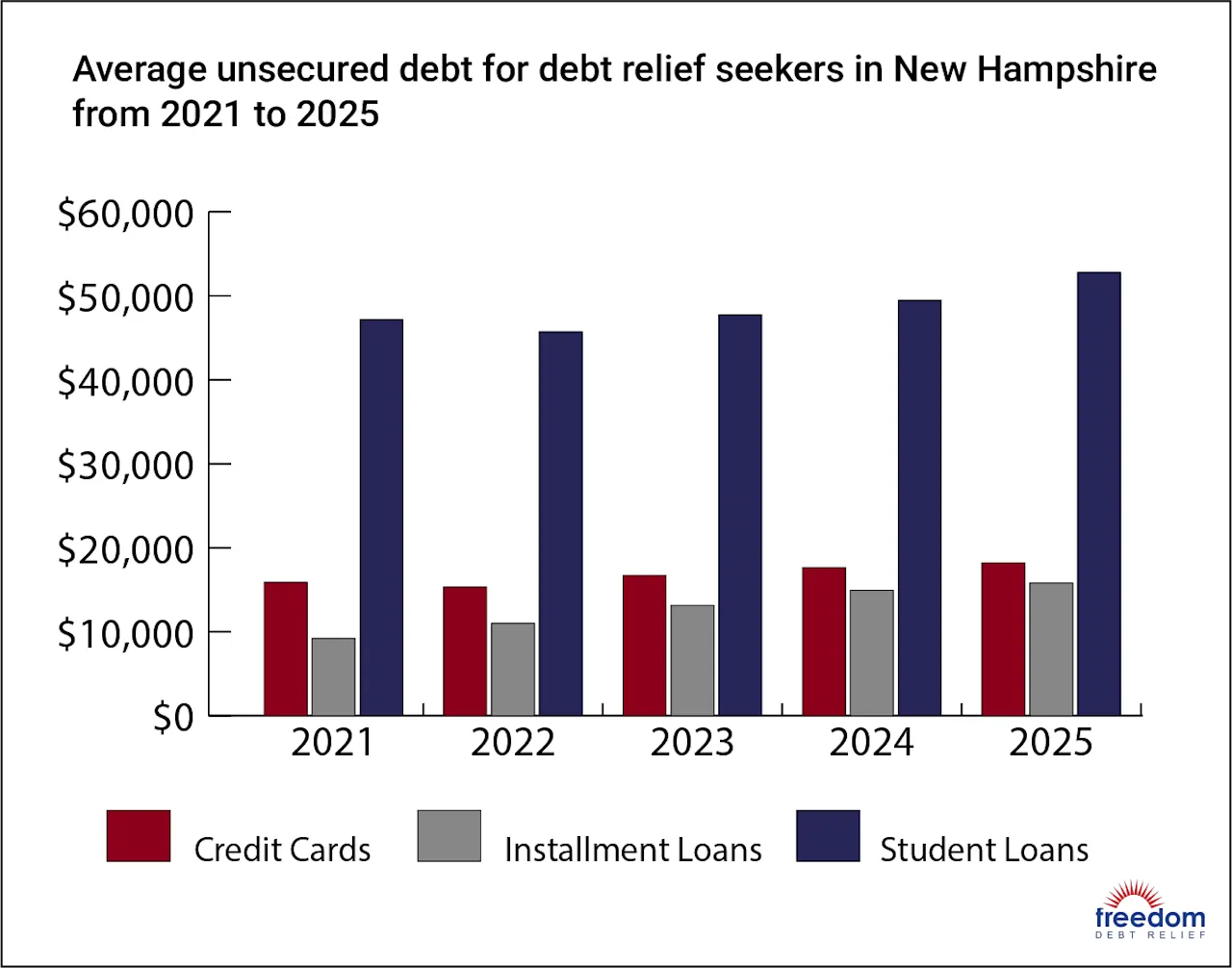
Overall, debt levels among debt relief seekers in New Hampshire rose between 2020 and 2025. That could suggest that more people are leaning on credit cards to get by, or that they're taking on more personal loan or auto loan debt.
Here's how debt levels have changed, according to Freedom Debt Relief's research.
New Hampshire Average Household Debt
| Year | Debt balance |
|---|---|
| 2020 | $27,036 |
| 2021 | $23,149 |
| 2022 | $26,607 |
| 2023 | $29,356 |
| 2024 | $33,520 |
| 2025 | $33,474 |
If you look at what New Hampshire debt relief seekers owe all together, including mortgage debt, student loans, credit cards, installment loans, and auto loans the numbers are much higher. Total debt comes to $356,434 on average, well above the $345,211 in household debt the typical American carries.
Here are some other notable five-year debt trends for New Hampshire.
In 2025, debt relief seekers owed $18,192 to their credit cards, a jump from the $15,886 owed on average in 2020.
The average debt-to-income ratio (DTI), which measures how much of your gross pay goes to debt payments each month, rose from 32.5% to 41.4%.
Residents have taken on more installment loans. In 2020, the average balance among debt relief seekers was $9,218; in 2025, it reached $15,811.
Collection accounts decreased from 2.2 on average to 1.6. Collection balances, meanwhile, dropped slightly from $2,346 to $2,241.
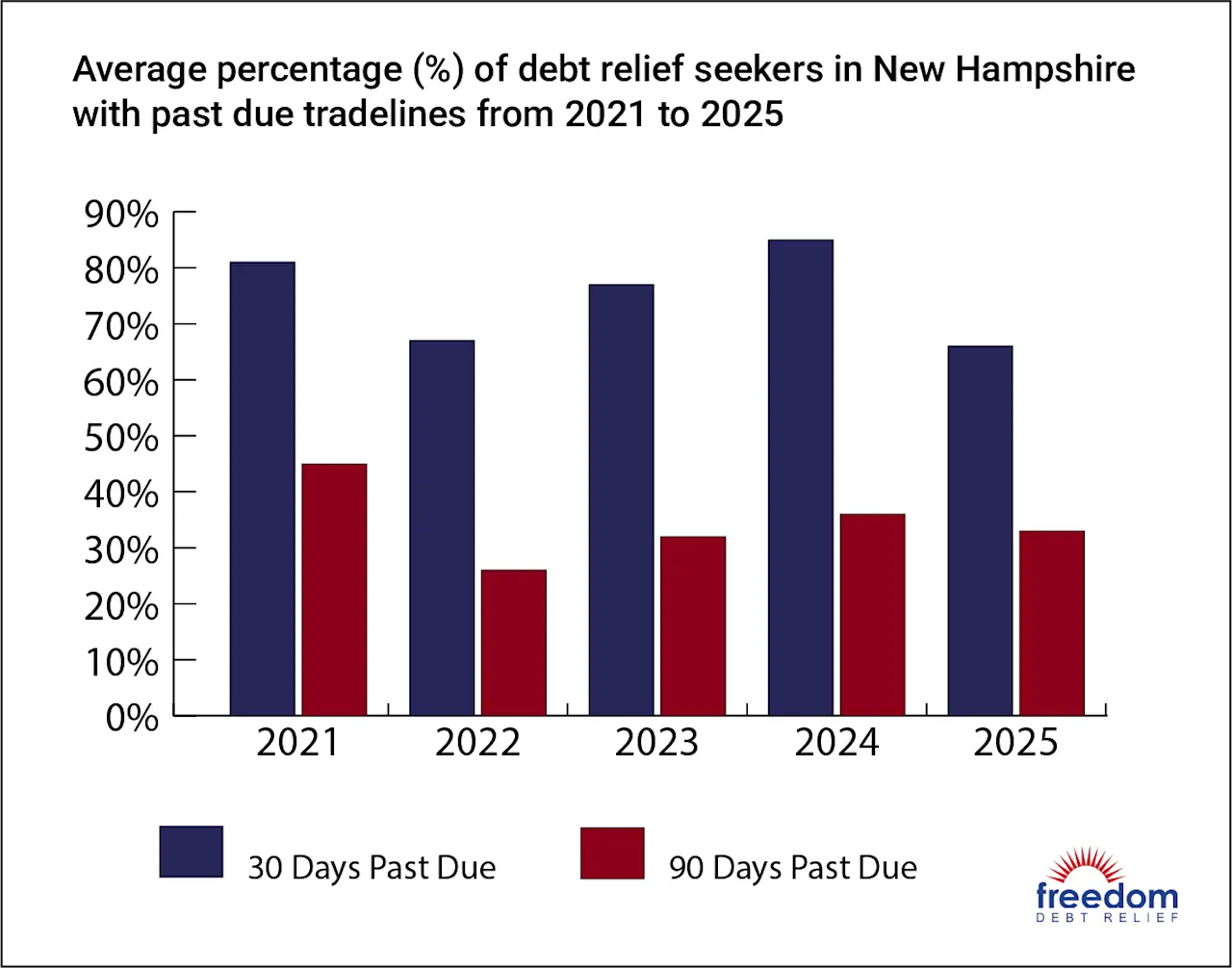
The number of accounts 30 days past due fell from 0.8 to 0.7, while the number of accounts 90 days past due declined from 0.5 to 0.3
The takeaway? New Hampshire residents who need debt relief owe more than they did five years ago, and they spend more of their income on debt repayment. They're doing a better job of staying current on debt payments, but balances for all debt types increased.
New Hampshire credit card debt
Credit card debt can be tough to pay down if you're stuck with a higher interest rate and only make the minimum payments. People in New Hampshire who seek debt relief:
Have 8 credit card accounts on average
Owe $18,192 on average, as of 2025
Pay $536 to their cards on average monthly
Have an average past due credit card balance of $6,455
Nationwide, credit card users looking for help with debt owe $16,244 on average across seven cards and pay $489 on average per month. They're past due on $5,793 in credit card debt. Credit card utilization in New Hampshire is slightly lower, at 70.2%, compared to 73.5% for debt relief seekers across the U.S. on average.
Credit card debt relief programs can help relieve some of the burden if you have a financial hardship that limits your debt repayment progress. You could get rid of debt for less than what you owe, and trim years off your payoff.
Who has the most credit card debt by age in New Hampshire? Here's the breakdown.
Average credit card debt by age for New Hampshire
| Age Group | Average Credit Card Debt | Average Total Debt |
|---|---|---|
| 18-25 | $6,496 | $22,532 |
| 26-35 | $14,302 | $31,263 |
| 36-50 | $18,277 | $35,095 |
| 51-65 | $19,686 | $35,553 |
| 65+ | $18,851 | $30,319 |
It's no surprise that debt relief seekers in midlife have the most credit card debt and highest debt overall. Marriage, kids, and buying a home can all drive up expenses, potentially leading to more regular credit card use.
New Hampshire auto loan debt
New Hampshire residents seeking debt relief owe $25,073 in auto loans and have 1.5 loans on average. Both auto loan balances and monthly payments have increased year over year since 2020.
Residents aged 36 to 50 owe the most, at $27,771 on average.
The highest earners carry much more auto loan debt than any other income group, at $73,853 on average.
Here's how New Hampshire residents looking for debt relief compare to debt relief seekers nationwide.
Auto loan debt among NH debt relief seekers
| New Hampshire Residents | U.S. Borrowers | |
|---|---|---|
| Total Balance | $25,073 | $26,697 |
| Monthly Payment | $694 | $749 |
| Average Number of Loans | 1.5 | 1.5 |
Given the higher costs to buy a car, an auto loan is pretty common. That doesn't make it so-called good debt, especially if your car loses value faster than you pay down the balance.
Auto loans aren't eligible for debt relief in most cases. One exception is if you owe a deficiency balance after your car is repossessed.
A deficiency balance means the lender auctioned off the vehicle but couldn't get enough money to cover what was left on the loan. So, they expect you to pay the difference. New Hampshire debt relief could help you resolve deficiency balances.
New Hampshire mortgage debt
New Hampshire residents looking for help with debt and who have a mortgage owed $244,570 on average in 2025. That's up from $207,046 five years ago. The average number of loans is 1.2, which could mean homeowners have yet to borrow against their equity.
Mortgage debt is highest among 26- to 35-year-olds, which makes sense since that's when many people decide to buy a home for the first time. Among debt relief seekers in this age range, the average balance is $316,672.
High-income earners don't shy away from more expensive homes. Debt relief seekers who make the most money also owe the most on their mortgage: $828,360 on average.
Here's how the state mortgage debt for New Hampshire residents seeking debt relief compares to the national average for people seeking debt relief.
Mortgage debt among New Hampshire debt relief seekers vs. U.S. borrowers
| New Hampshire Residents | U.S. Borrowers | |
|---|---|---|
| Total Balance | $244,570 | $239,406 |
| Monthly Payment | $2,196 | $1,989 |
| Average Number of Loans | 1.2 | 1.2 |
How much does it cost to buy a home in New Hampshire? The average home value was $496,656 as of December 2025. That's substantially higher than the nationwide average of $360,727.
New Hampshire installment loan debt
Installment loans let you borrow a lump sum and pay it back over time, usually at fixed interest rates. Personal loans are one type of installment loan you might have.
New Hampshire debt relief seekers have 2.7 installment loans on average, and owe $15,811. Compared to people looking for help with debt nationwide, Granite State residents rely more heavily on installment loans to meet their financial needs.
Installment loan debt among NH debt relief seekers compared to U.S. borrowers
| New Hampshire Residents | U.S. Borrowers | |
|---|---|---|
| Total Balance | $15,811 | $12,632 |
| Monthly Payment | $503 | $485 |
| Average Number of Loans | 2.7 | 2.8 |
Installment loans could be a candidate for New Hampshire debt relief if they're unsecured. An unsecured debt isn't attached to any collateral, like a home or a car.
New Hampshire student loan debt
As college grows more expensive, student loan debt increases. The average New Hampshire resident seeking debt relief owes $52,788 in student loan debt. New Hampshire residents pay just $344 per month to their loans, which could take 20 years to pay off, if you assume a 5% interest rate.
Highest earners have the most student loan debt on average, at $95,422.
Balances are highest among debt relief seekers aged 51- to 65-year-olds; they owe $60,322 on average.
Here's how New Hampshire student loan debt stacks up against student debt averages for debt relief seekers in the U.S.
NH student loan debt
| New Hampshire Residents | U.S. Borrowers | |
|---|---|---|
| Total Balance | $52,788 | $49,932 |
| Monthly Payment | $344 | $313 |
| Average Number of Loans | 5.2 | 5 |
New Hampshire Debt Delinquencies and Collections
Unpaid debts can eventually end up in collections. That's when the calls and letters from debt collectors begin.
Among New Hampshire debt relief seekers, collection balances average $2,241. Overall, the number of balances in collections and collection accounts has trended down since 2020.
Here's how residents compare to debt-relief seekers in the rest of the country.
NH debt delinquencies and collections
| New Hampshire Residents | U.S. Borrowers | |
|---|---|---|
| Average Number of Collection Accounts | 1.6 | 1.9 |
| Accounts Past Due 30 Days | 0.7 | 0.6 |
| Accounts Past Due 60 Days | 0.3 | 0.3 |
| Average Collection Balance | $2,241 | $3,040 |
| Average Collection Past Due Amount | $2,214 | $2,884 |
Debt relief in New Hampshire can help with collection accounts. Of course, whether you seek debt relief for collection balances may depend on whether the statute of limitations has expired or not.
New Hampshire Statute of Limitations
The statute of limitations on debt specifies how long a creditor has to sue you for an unpaid balance. Once the clock runs out you can't be sued. However, you still owe the debt.
Each state's laws are different. Here's how much time creditors have to bring a debt lawsuit for different types of debt in New Hampshire.
NH Statute of Limitations for Debt
| Type of Debt | Statute of Limitations |
|---|---|
| Credit cards | 3 years |
| Medical debts | 3 years |
| Auto loans | 3 years |
| Private student loans | 3 years |
| Mortgages | 20 years |
| Personal loans | 3 years |
| Judgments | 20 years |
| Oral contracts | 3 years |
| Promissory notes | 6 years |
| State tax debt | 3 years |
Compared to other states, New Hampshire gives creditors less time to try to sue. Be careful not to restart the clock on past due debts. If you make a payment, agree to pay, or simply acknowledge that you owe the debt, that could reset the statute of limitations and give your creditor more time to sue you for credit card debt.
What are the New Hampshire debt collection laws?
New Hampshire law prohibits debt collectors from engaging in certain practices. Revised Statute § 358-C:3 says that debt collectors can’t:
Harass you with continuous phone calls
Call you at work if you specify that you can't receive personal calls
Threaten you with violence or use of force
Fail to identify themselves in any written communications they send
Make false claims about the debt, such as the amount owed
Misrepresent who they are when they contact you
Use abusive language in conversations
Collect interest or fees they're not entitled to
Threaten to sue you or garnish your wages/bank accounts if they don't actually intend to do so
These guidelines mirror those in the Fair Debt Collection Practices Act (FDCPA). The FDCPA is a federal law that protects consumers from unfair or harmful debt collection practices.
If a New Hampshire debt collector contacts you, you have the right to request validation of the debt. You also have the right to ask them not to contact you about the debt again.
New Hampshire Debt Relief
Borrowers with financial hardship in New Hampshire have options for finding relief from overwhelming debt.
Here's how a typical debt settlement program works:
A debt expert reviews your debts and budget to decide on an affordable monthly payment.
Once enrolled, you make a monthly deposit into a dedicated account. You own and control the account; the funds are always yours. This is where you’ll build up funds for settlement offers.
Your debt expert negotiates settlements with your creditors.
When your creditor and negotiator reach an agreement, it’s presented to you for approval.
If you approve, funds in your dedicated account are used to pay your creditor. The debt settlement company’s fee is paid from the same account.
Once the terms of the agreement are satisfied, the rest of the debt is forgiven.
If you need help, Freedom Debt Relief may be able to refer you to a provider in your area who offers the services you need. Call 800-910-0065 to talk to a debt specialist.
Freedom Debt Relief does not provide debt settlement services for people in New Hampshire. You may be referred to a third party provider or law firm.
Is Debt Consolidation the Best Debt Solution?
Debt settlement is one way to deal with debt; consolidation is another. When you consolidate debt, you don't reduce what you owe. Consolidation could make the debt easier to manage.
Here are three ways you might consolidate debt in New Hampshire.
Debt consolidation loan. Debt consolidation loans are personal loans. You borrow a lump sum, use it to pay off credit cards or other debts, then repay the consolidation loan in monthly installments. The goal is to borrow the funds at a lower interest rate than you currently pay. Most personal loans for debt consolidation are unsecured, meaning you don’t have to risk anything of value by using it as collateral.
Home equity loan. A home equity loan lets you borrow against your home and use the funds to pay off debt. Because home equity loans are secured by the home, they often have a lower interest rate compared to other options.
Cash-out mortgage refinance. A cash-out refi replaces your old mortgage with a new one, and lets you take out cash from your equity at closing. You could use a cash-out refi to pay off your old mortgage and still have money left over to pay off credit cards and other debts.
Who may benefit from debt consolidation vs. debt settlement
Typically, the consumer who benefits most from a debt consolidation loan has more manageable debt levels and a credit score that lets them qualify for a low interest rate. A consolidation loan can help to streamline their budgets and potentially save on interest.
If you have a financial hardship that makes it difficult to pay, debt settlement can offer relief. You can pay off debt for less than what's owed legally and get your finances back on track.
How to qualify for debt consolidation in New Hampshire?
To qualify for debt consolidation in New Hampshire, you typically need to have:
A fair or good credit score
Steady income
A debt-to-income ratio below 50%
A good credit score can make it easier to get approved for a consolidation loan. If your score isn’t high right now, think about what you can do to improve it. Timely payments, for example, can help add points to your score.
Also, consider how you can reduce your DTI. For example, could you pay off one small credit card balance now to get rid of that monthly payment? A lower DTI can work in your favor for loan approval.
Whether you choose debt consolidation or debt settlement, the most important thing is taking action. The first step may be difficult but you'll thank yourself later when your debt is under control.
New Hampshirites can free up cash each month with Freedom Debt Relief
Ozzy S., Freedom client²
“Right away, I had more money each month because of program costs so much less than what I was paying on my minimums.”
Frequently Asked Questions
Is there a government debt relief program for New Hampshire?
No. Neither the New Hampshire government nor the federal government offers debt relief programs for credit cards. There are programs that can help with utility bills, rental assistance, and food assistance; eligibility is usually income-based. If you need help with debt in New Hampshire, you can look into debt relief programs. With debt relief, you could pay off debts for less than what you owe and get rid of debt faster than minimum payments.
Is it worth doing a debt relief program?
It could be. If you’ve been through a financial hardship and don’t have a way to repay what you owe in unsecured debt (like credit cards, personal loans, and medical bills), a debt relief program could be worth exploring. You do need to be able to afford a monthly payment to build up funds to offer creditors to settle debts. If you can’t manage any payment, Chapter 7 bankruptcy may be a better fit for you.
Can you be sued for old debts in New Hampshire?
Generally, you can't be sued for debts in New Hampshire if the statute of limitations has expired. For most debts, the statute of limitations lasts three years. If you have debts that are older than that, you still owe them. It's up to you to decide if you want to pay them or not, and debt collectors can still contact you to ask for payment. New Hampshire debt relief could help you resolve old debts and put an end to collection calls.
End Your Debt
Find out how our program could help.
- One low monthly program deposit

- Settlements for less than owed
- Debt could be resolved in 24-48 months