Nebraska Debt Relief by the Numbers: 5-Year Debt Trends
Although the cost of living in Nebraska is about 12.2% lower than the national average, many people in the state are struggling with debt. In 2024, the median income in Nebraska was about $76,400. And the average person in Nebraska owed about $48,800 in debt as of 2024, according to the Center for Macroeconomic Data. In comparison, the average debt on a national level in 2024 was $62,000.
If you're overwhelmed by debt in Nebraska, know that you aren’t alone. Data from Freedom Debt Relief shows that many people in Nebraska are having a hard time managing their debt. But there’s help available.
We’ll review debt trends in Nebraska since 2020, discuss how debt balances have changed, and consider what you can do if you’re struggling to keep up with your debt.
Nebraskans can free up cash each month with Freedom Debt Relief

Ozzy S., Freedom client²
“Right away, I had more money each month because of program costs so much less than what I was paying on my minimums.”

Excellent •
5-Year Debt Trends in Nebraska
In 2025, many Americans are living paycheck to paycheck, according to Bank of America data. That’s causing a lot of people to fall behind on their debts. Nebraskans are no exception. Debt relief seekers in Nebraska saw their debt increase from $22,287 in 2020 to $30,111 in the first half of 2025—a roughly 35% increase.
The average minimum monthly debt payment among debt relief seekers rose from $1,582 in 2020 to $1,742 in June 2025—a 10% increase.
FICO Scores have also decreased among Nebraska debt relief seekers. In 2020, they had an average FICO Score of 616, but in the first half of 2025, that number fell to 595. Still, that’s higher than the June 2025 average 592 credit score among debt relief seekers across the U.S.
Meanwhile, debt relief seekers in Nebraska had an average debt-to-income (DTI) ratio of 30% in 2021. In the first half of 2025, that number rose to 39.8%, which shows that many people struggling with debt are spending a greater proportion of their income on it.
On a national scale, debt relief seekers had a DTI of 42.3% in June 2025, so Nebraska debt relief seekers may not be spending quite as much of their income on debt payments as their peers across the U.S.
However, total debt is on the rise in Nebraska. Between 2020 and June 2025, total unsecured debt among debt relief seekers (including credit card balances, installment loans, and student loans) rose from $70,158 to $72,011.
Their secured debt (including mortgages and auto loan balances) increased from $153,954 in 2020 to $203,085 in June 2025. And total debt (secured plus unsecured) rose from $224,112 in 2020 to $275,096 in the first half of 2025. On a national scale at that time, total debt was $345,211.
Debt levels also rose between 2020 and 2025 among low- and moderate-income Nebraska debt relief seekers. In 2020, low-income debt relief seekers owed an average of $12,021, and moderate-income debt relief seekers owed $23,290. By mid-2025, these numbers had risen to $18,611 for people with low incomes, and $26,822 for moderate earners.
Among Nebraska debt relief seekers with poor credit, average debt fell from $30,243 in 2020 to $26,718 in June 2025. But debt relief seekers with fair credit saw their debt increase from $24,457 in 2020 to $29,365 in June 2025.
The good news is that young debt relief seekers’ FICO Scores have improved through the years. In 2021, debt relief seekers aged 18 to 25 had an average 510 FICO Score. By mid-2025, the average score for that age group was 572.
Nebraska credit card debt
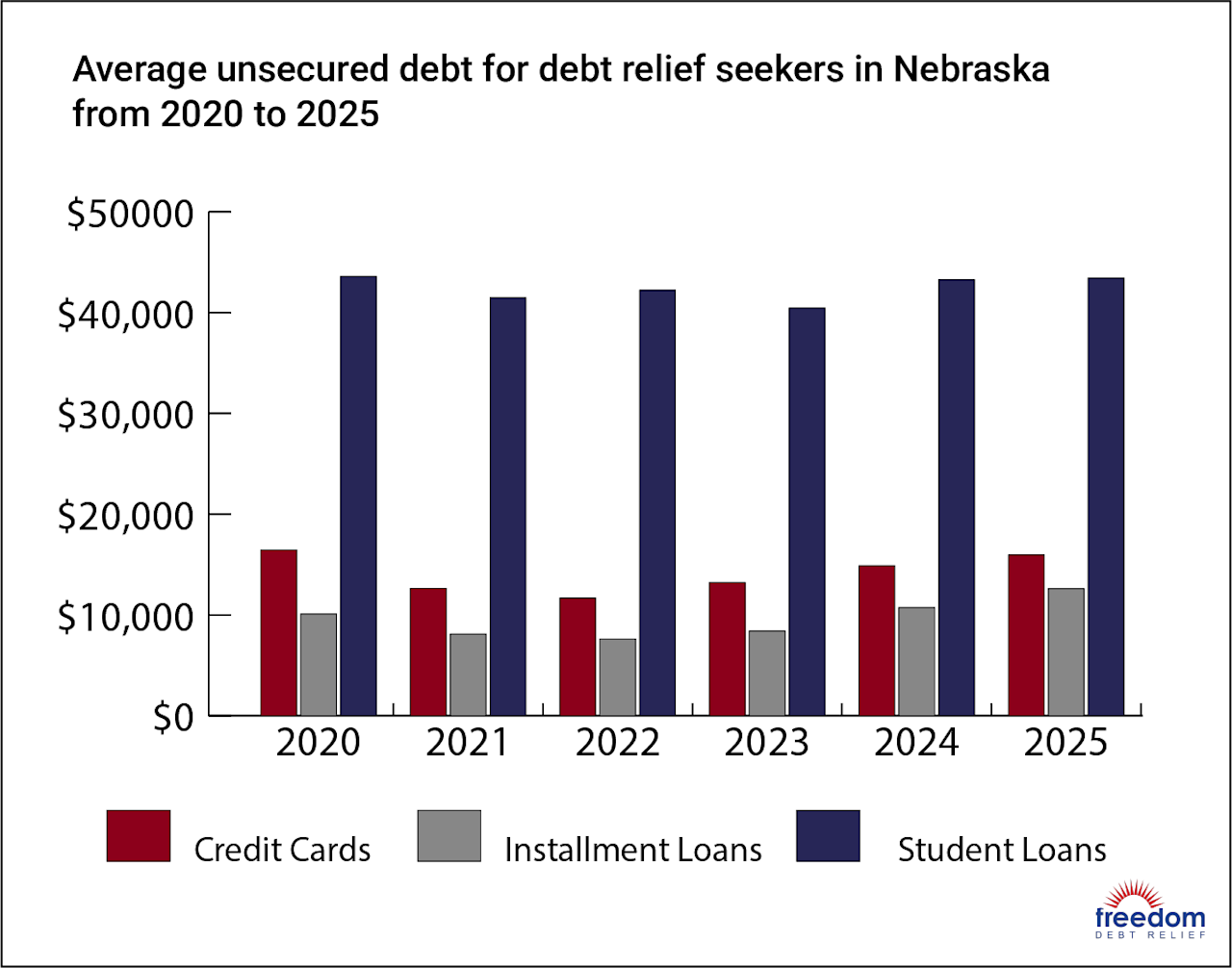
Among Nebraska debt relief seekers, average credit card balances fell from $16,457 in 2020 to $15,971 in June 2025. That's lower than the national average credit card balance of $16,244 in June 2025 among debt relief seekers.
The average monthly credit card payment, however, increased for Nebraska residents seeking debt relief, despite balances falling. In 2020, that average payment was $465. It was $495 in mid-2025. That's a bit above the average monthly $489 credit card payment among debt relief seekers nationally as of mid-2025.
Credit utilization, meanwhile, rose among Nebraska debt seekers, going from 64.9% in 2020 to 71.1% in June 2025, below the national average of 73.50% among debt relief seekers. A high amount of credit utilization can lead to a lower credit score and make it hard to keep up with credit card payments.
The average number of open credit card accounts held by debt relief seekers in Nebraska fell from 8.2 to 7.3 during that same five-year period. That's roughly in line with the June 2025 national average among debt relief seekers of 7.4.
Credit card debt can be difficult to pay off because credit cards typically charge very high interest rates. Credit card interest can also compound frequently, making it easier for that interest to build up against you. If you’re struggling to keep up with your credit card debt, it could pay to seek credit card debt relief.
Nebraska auto loan debt
Among debt relief seekers, the average auto loan balance in Nebraska rose from $22,901 in 2020 to $25,731 in June 2025. That's a bit below the average auto loan balance among debt relief seekers nationally, which is $26,997 in June 2025.
Meanwhile, the average monthly auto loan payment among debt relief seekers in Nebraska rose from $602 to $717 during that same time period. Despite the increase, that $717 average monthly car loan payment is lower than the average monthly auto loan payment of $749 in mid-2025 across debt relief seekers nationally.
Nebraska mortgage debt
Among debt relief seekers, the average mortgage balance in Nebraska went from $131,053 in 2020 to $177,355 in June 2025. That’s well below the average mortgage balance of $239,406 of debt relief seekers nationally at that time.
The average monthly mortgage payment among debt relief seekers in Nebraska increased from $1,192 in 2020 to $1,724 in mid-2025. On a national scale, debt relief seekers had an average mortgage payment of $1,989 in mid-2025.
Nebraska installment loan debt
Among debt relief seekers in Nebraska, the average installment loan balance rose from $10,117 in 2020 to $12,618 in June 2025, marking a 13.5% increase. That average loan balance is comparable to the average installment loan balance among all U.S. debt relief seekers of $12,632 in June 2025.
The average monthly installment loan payment for Nebraska debt relief seekers, meanwhile, rose from $359 in 2020 to $526 in June 2025. That's higher than the average monthly installment loan payment of $485 among national debt relief seekers in the same time period.
Nebraska student loan debt
Among debt relief seekers, the average student loan balance in Nebraska fell from $43,584 in 2020 to $43,422 in June 2025. That's well below the average student loan balance of $49,932 among debt relief seekers across the U.S. in that same period.
Nebraska debt relief seekers had an average monthly student loan payment of $223 in 2020. The monthly average payment rose to $274 in mid-2025. On a national scale among debt relief seekers, the average monthly student loan payment as of June 2025 is $313.
If you’re struggling to repay your federal student loans, you may be eligible for relief in the form of forbearance, deferment, or an income-driven repayment plan.
Nebraska Debt Delinquencies and Collections
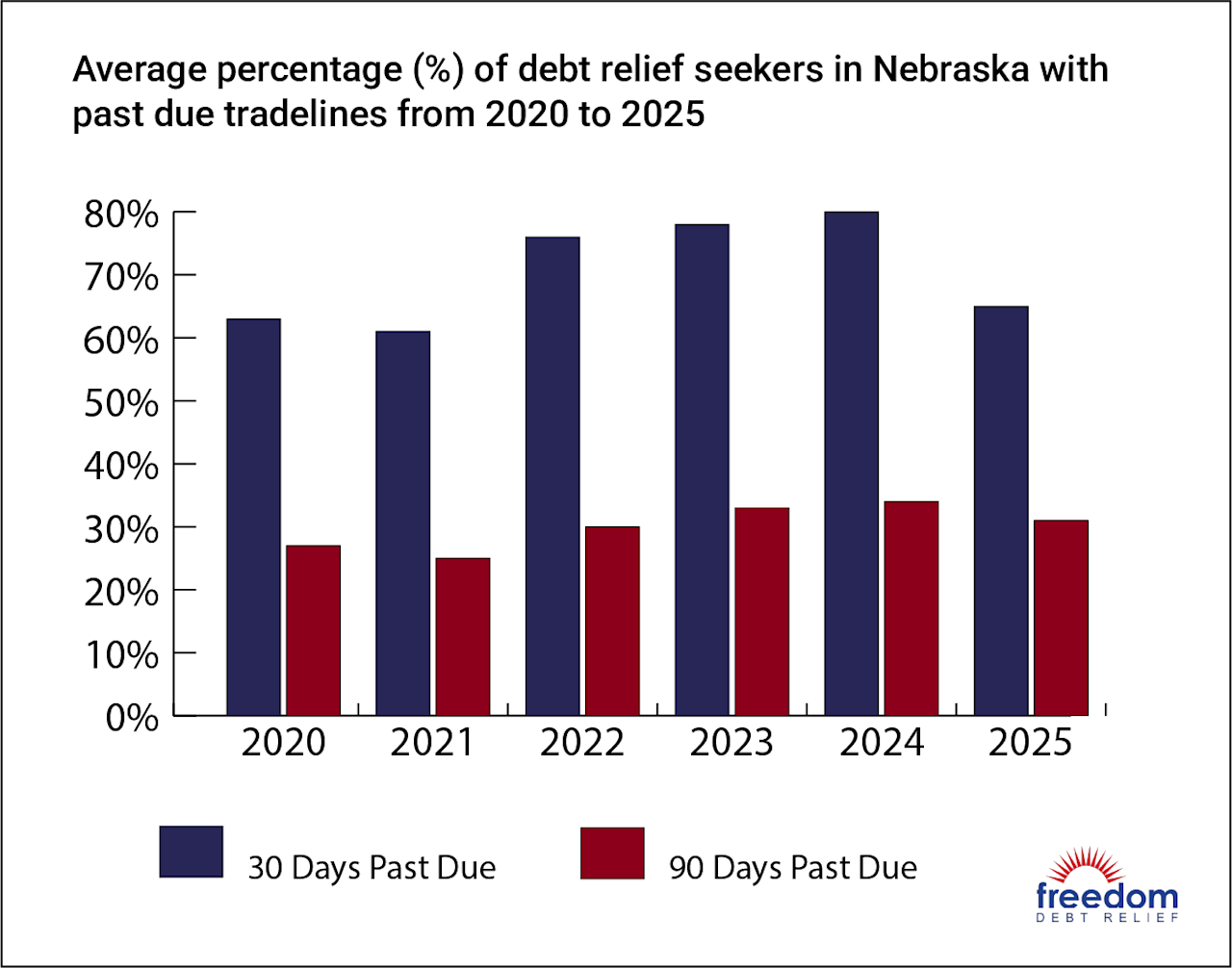
Among debt relief seekers in Nebraska, there were 2.9 accounts in collections on average in 2020, compared to 2.0 in June 2025. The average balance in collections also fell from $4,471 in 2020 to $3,320 in June 2025. Among debt seekers nationally, the average collections balance was $3,040 in June 2025.
It’s not just debt relief seekers who are falling behind on their debt. Here’s how all Nebraska residents are faring in terms of debt delinquencies, according to data from TransUnion.
| Type of debt | 30-plus days past due | 60-plus days past due | 90-plus days past due |
|---|---|---|---|
| Auto loan | 3.21% of consumers | 1.27% of consumers | Data not available |
| Credit card | 3.68% of consumers | 2.54% of consumers | 1.83% of consumers |
| Mortgage | 2.05% of consumers | 0.94% of consumers | 0.56% of consumers |
The longer a debt is past-due, the more impact it can have on a credit score. Also, with secured debts like auto loans and mortgages, borrowers with past-due debts risk repossession or foreclosure.
Nebraska Statute of Limitations
A statute of limitations is the amount of time a creditor could successfully sue you to collect an unpaid debt. After the statute of limitations runs out, debt collection lawsuits generally get dismissed because the debt has become “time-barred.” Note as well that if you make any payments on a debt after it becomes time-barred, it restarts the clock. Here’s an overview.
| Type of debt | Nebraska statute of limitations |
|---|---|
| Credit cards | 5 years |
| Most medical debt | 4 years |
| Personal loans | 5 years |
| Auto loans | 5 years |
The statute of limitations clock usually starts on the date of your last payment. For installment loans like personal or auto loans, the clock starts on the date your payment is due.
What are the Nebraska debt collection laws?
The Fair Debt Collection Practices Act (FDCPA) outlines the rules for how debt collectors can legally try to collect debts. It applies to the U.S. as a whole, including Nebraska.
Debt collectors may not call you at an unreasonable hour, harass you, or use threatening language. They also cannot tell others about your debt.
Nebraska also has a Collection Agency Act that dictates the rules for collecting public debts owed to a state agency or other public entity. Anyone collecting debts on behalf of another party in Nebraska must also be licensed.
Reviews and Testimonials from Nebraska
They answer your calls or return them. You can talk to a person who is knowledgeable and courteous.
Mary Leu, US
The process is fast and the people are nice I’m having a good experience
Cindy Fitch, US
Well they are doing what they said they would do and my credit scores shot up, even though they went back down because of insurance company said I owe and I don't but hopefully it'll go back up soon
Brenda Larsen, US
Nebraska Debt Relief
If you have overwhelming debt, a debt relief program could be a good option. With this kind of program, a debt settlement company negotiates with creditors on your behalf. You typically make a monthly deposit into a dedicated account that you own and control, and that money is used to repay your debts.
A debt relief program is typically best for people who are far behind on their debts and don't have a path toward paying them off completely. It’s possible to complete a debt relief program in as little as two to four years.
To learn more about your debt relief options in Nebraska, contact Freedom Debt Relief to request a consultation. A Debt Consultant can speak to you about your financial situation, and work with you on a debt relief plan.
Is Debt Consolidation the Best Debt Solution?
If you’re struggling with debt but aren’t missing payments, debt consolidation may be the right choice for you. Debt consolidation is when you take a new loan and use it to pay off other debts. It could make your debts easier to manage by lowering the number of monthly payments, but better yet, if you can also get a lower interest rate, you might find it more affordable.
If you have a lot of high-interest credit card debt, you may be able to lower your interest rate by paying if off with:
A personal loan
A home equity loan or line of credit
A 0% balance-transfer credit card (caution: it can be easy to rack up new debt unless you stick to a very firm plan to pay off the card during the 0% period)
Debt consolidation could make the most sense if you:
Have a strong enough credit score to qualify for a debt consolidation loan or balance transfer credit card
Have planned ahead and know you can pay off the new debt
Other Debt Relief Alternatives in Nebraska
Here are some other debt relief options that may be all or part of the solution for your situation:
Debt settlement. You can negotiate for yourself, or a debt relief company can negotiate with creditors on your behalf. Debt settlement seeks to reduce the amount of total debt you owe. It does damage your credit score.
Hardship programs. These are arrangements some creditors offer to make it easier to pay what you owe. They may include delaying or reducing monthly payments, suspending late fees, or lowering your interest rate.
Income-driven repayment plans. These are most commonly offered in connection with government-backed student loans. These plans base your monthly payment on the amount of money you make. This can help you afford student loan payments on a low income. Some income-driven repayment plans have recently become unavailable, so check with the U.S. Department of Education for the latest.
Credit counseling. Credit counseling could mean different kinds of help. It may simply entail having a qualified credit counselor explain your various debt relief options to you. Or it may involve a debt management plan. This is an ongoing relationship in which the credit counselor can help you manage your debt payments.
DIY debt payoff. You can pay off your own debts at your own pace by setting a budget and allocating money to your debt every month. Common strategies for this include the avalanche method, in which you pay off your debts from highest interest rate to smallest, or the snowball method, in which you pay off your debts from smallest balance to largest.
Bankruptcy. This is a legal solution. A court decides how to use your income or assets to settle your debts to the extent possible. If no other debt relief solution seems as if it will work, bankruptcy could get debt collectors off your back so you can start over.
Nebraskans can free up cash each month with Freedom Debt Relief
Ozzy S., Freedom client²
“Right away, I had more money each month because of program costs so much less than what I was paying on my minimums.”
Excellent •
What are the debt consolidation options available in Nebraska?
There are several options for debt consolidation in Nebraska. The right choice for you depends on your specific financial situation.
You can consolidate your debt into an unsecured personal loan, which usually comes with fixed monthly payments. Or, if you own a home, you can look at consolidating your debt into a home equity loan or cash-out refinance, in which you borrow more than your remaining mortgage balance.
A balance transfer credit card may also be an option for debt consolidation, and many of these offers come with a 0% introductory interest rate. But be careful, because if you don't repay your entire balance by the end of your introductory period, your interest rate could skyrocket.
You may also be able to get onto a debt management plan (DMP), which consolidates your debt and requires a single monthly payment through a credit counseling agency. The agencies that offer these plans typically charge for their services.
What are the typical interest rates for debt consolidation loans in Nebraska?
The interest rate for a debt consolidation loan depends on a number of factors, including the type of loan you take out, the amount of your loan, and your credit score.
With an unsecured personal loan, the stronger your credit score is, the lower the interest rate you may qualify for. Working to boost your credit score before taking out a debt consolidation loan could result in lower monthly payments.
Personal loans are a popular choice for debt consolidation. Depending on your credit score, you might pay anywhere from about 7% to 36%, a very wide range, so if you're looking to consolidate your debt, shop around to see what rate lenders offer you. Then you can calculate your monthly payments to see if they're affordable.
What credit score is generally required for a debt consolidation loan in Nebraska?
The credit score you need to qualify for a debt consolidation loan in Nebraska depends on your lender and the specific type of loan you seek. Personal loans are a popular type of debt consolidation loan, and they're unsecured (not tied to a specific asset that a lender can sell or repossess, like a home or car, to get its money back).
If you're taking out a personal loan, your lender may require a minimum credit score of 580. But some lenders require an even higher score, depending on the amount of money you're looking to borrow. The higher your credit score, the more likely you are to get a competitive interest rate on a debt consolidation loan.
Are there any Nebraska consumer protection laws?
Nebraska's Collection Agency Act outlines the rules for collecting public debts owed to a state agency or other public entity. Anyone collecting debts on behalf of another party in Nebraska must also be licensed.
How do you find reputable debt consolidation companies or credit counseling agencies in Nebraska?
To find a reputable debt consolidation company or credit agency in Nebraska, start with the National Foundation for Credit Counseling (NFCC). The NFCC's website can connect you with a certified counselor.
The U.S. Department of Justice also maintains a list of approved credit counseling agencies. You can find your judicial district by state and country, and get further information.
Check the credentials of any debt consolidation company or credit counseling agency you're considering. Once you've narrowed down your choices, you can check them out with your state attorney general and the Better Business Bureau to see if complaints have been filed against them.
Ask plenty of questions when getting a consultation. And be wary of red flags like a very high upfront fee, or high-pressure tactics.
What are the pros and cons of debt consolidation for Nebraska residents?
A big benefit of debt consolidation is having one fixed monthly payment instead of having to juggle multiple debt payments. Another benefit is that you might lower the interest rate on your debt with a consolidation loan. If you're juggling multiple credit card balances, for example, you may be able to lower your rate by consolidating them with a personal loan.
With a debt consolidation loan, you might also have a clearer payoff timeline, which could help keep you motivated and on-track. And if you make your consolidation loan payments on time, it could help your credit score.
One big downside of debt consolidation is that it won't wipe out any of your debt, and in some cases, it could cost you more in the long run, because loan fees can add up. And if you're paying off your debt over a longer period of time, you might accrue more interest.
If your credit needs work, you might struggle to qualify for a debt consolidation loan, or one with a competitive interest rate.
How does debt consolidation affect my credit score in Nebraska?
Debt consolidation could help your credit score, but it could also hurt it. If you make your debt consolidation loan payments on time every month, it could help your credit score improve by helping you establish a positive payment history.
In some cases, a debt consolidation loan might lower your credit utilization rate, a measure of how much of your available credit you're using. That could improve your credit score, too.
On the other hand, if you don't pay your debt consolidation loan on time, it could hurt your credit score. And if you consolidate your debt with a credit card balance transfer, it doesn't help your credit utilization.
Any time you apply for a new loan, it triggers a hard inquiry on your credit report, which could drop your score by a few points. However, if a debt consolidation loan makes it easier to keep up with your debt, timely payments could more than make up for the minor credit score hit a hard inquiry might cause.
What are the steps to apply for a debt consolidation loan in Nebraska?
If you're looking for a debt consolidation loan in Nebraska, start by checking your credit score and credit report. If there are mistakes on your credit report, get them corrected before you apply for a debt consolidation loan, since that could boost your credit score.
Next, make a list of your debts along with their interest rates so you understand exactly what you owe. Gather financial information a lender might need, including pay stubs, bank statements, and proof of employment.
After that, shop around for lenders. Local banks and credit unions may be a good place to start. When comparing lenders, pay attention to the interest rates and loan terms (such as the length of your repayment period). Find out what fees each lender charges, and what your monthly payments will look like.
What alternatives to debt consolidation are available for managing debt in Nebraska?
There are a number of alternatives to debt consolidation you may want to consider.
With a debt management plan, you work with a credit counseling agency to roll your debts into one monthly payment.
With debt settlement, your creditors agree to accept a lower amount than the total amount you owe. You can negotiate a debt settlement on your own, or with the help of a debt relief company. Debt settlement may be a good option if you feel you can’t pay your debt. However, debt settlement can have a negative impact on your credit score.
In some cases, budgeting carefully and using a debt payoff strategy could be a good alternative to debt consolidation. If you can set a meaningful amount of money aside each month for debt payoff purposes, you can tackle your debts in order of highest interest rate to lowest (the “debt avalanche”), or smallest balance to largest (the “debt snowball”)—whichever method works best for you.
How do current economic conditions impact debt consolidation decisions in Nebraska in late 2025?
Economic conditions impact the interest rate you might get on a loan. The lower the Federal Reserve's benchmark interest rate, the more affordable borrowing tends to be.
Interest rates have been somewhat elevated. However, the Federal Reserve lowered its benchmark rate by a quarter percent in December. Additional rate cuts could follow in 2026.
It’s also worth considering that the unemployment rate in Nebraska was 3% as of August 2025 (that’s lower than the national average). And having a steady job helps when you’re applying for a debt consolidation loan.
End Your Debt
Find out how our program could help.
- One low monthly program deposit

- Settlements for less than owed
- Debt could be resolved in 24-48 months