Missouri Debt Relief by the Numbers: 5-Year Debt Trends
Missouri residents have seen a slight decrease in debt over the last few years, according to the Federal Reserve Bank of New York. Their data shows Missourians had around $47,900 in average household debt in 2024. That's down from around $50,000 in 2020.
The U.S. overall saw a very similar trend, with average household debt hovering around $64,000 in 2020 and dropping to $61,700 in 2024. That's around $13,800—or 29%—higher than the typical Missourian's household debt.
While Missourians have less debt on average, they also tend to have lower incomes. The median household income for Missoui in 2024 was around $71,600. In comparison, U.S. households overall had a median income of $81,604—a difference of around $10,000 a year, or about 14%.
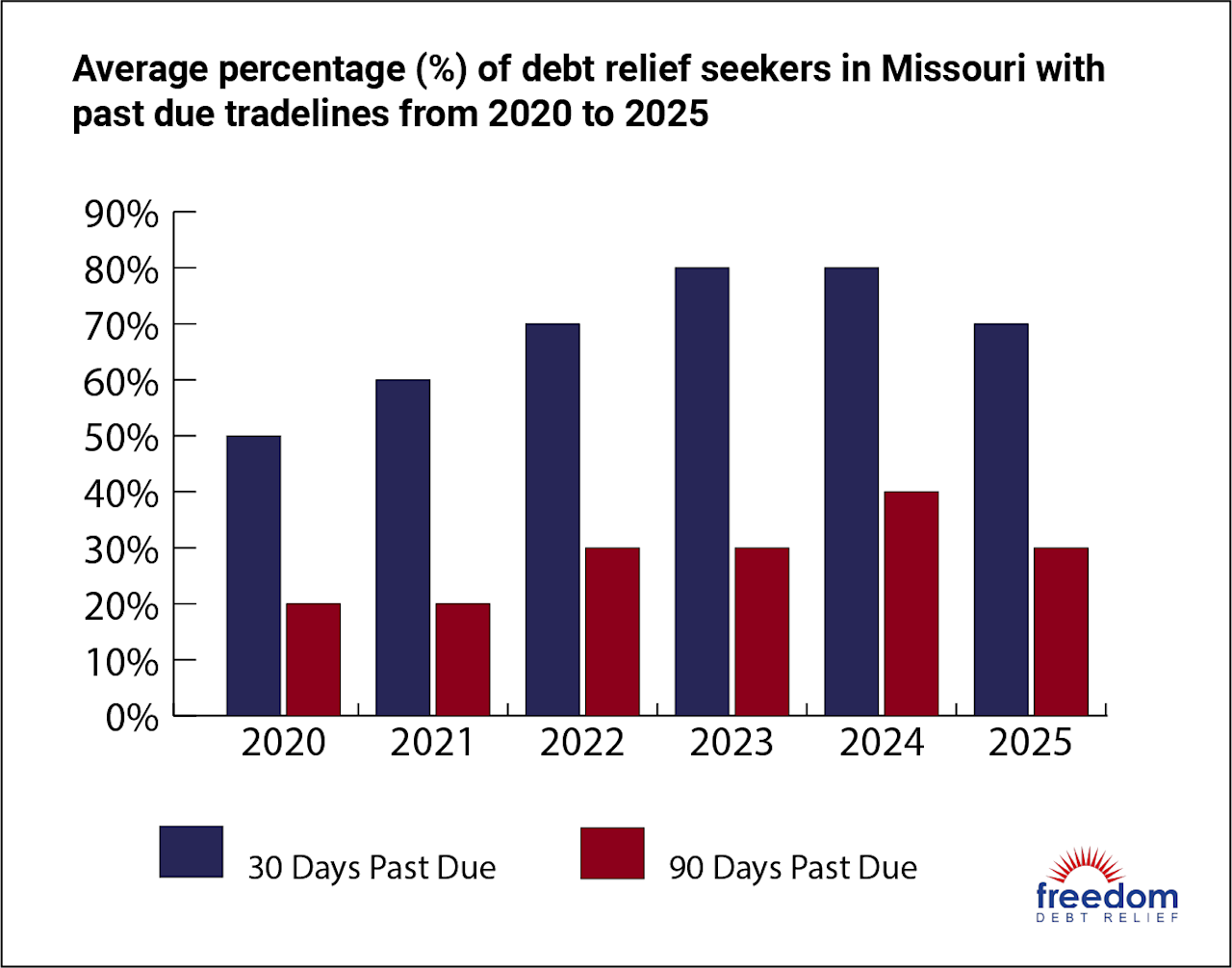
Despite overall debt decreasing, Missourians may be struggling with their debt more now than before. Freedom Debt Relief data shows a steady increase in the number of Missouri residents seeking debt relief over the last five years. Additionally, 81% of Missouri debt relief seekers were 30-plus days behind on at least one debt account in 2024, up significantly from 41% in 2020.
Missourians can free up cash each month with Freedom Debt Relief

Ozzy S., Freedom client²
“Right away, I had more money each month because of program costs so much less than what I was paying on my minimums.”

Excellent •
5-Year Debt Trends in Missouri
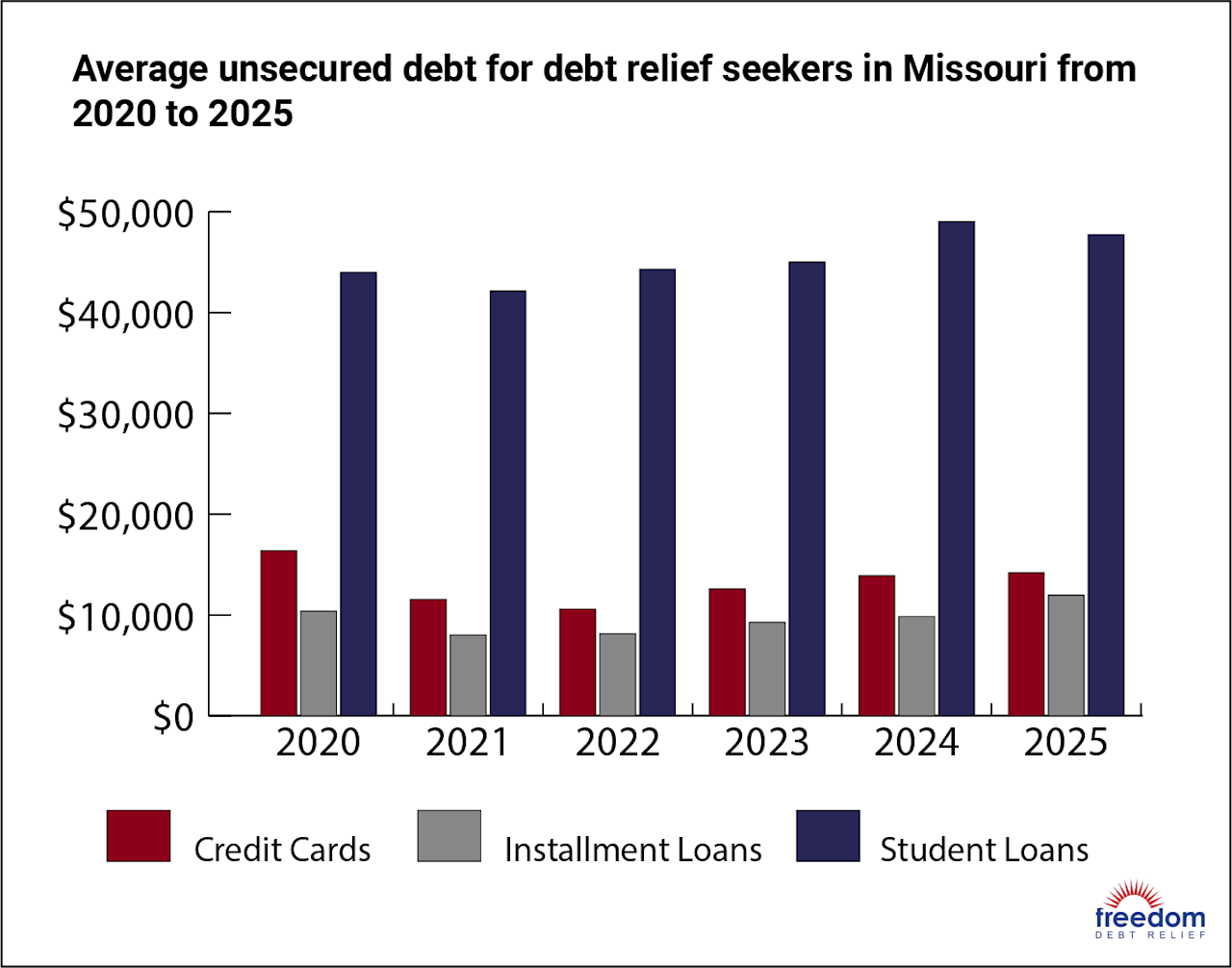
The good news for Missouri residents is that they may be having an easier time with credit card debt now than in 2020. Freedom Debt Relief data shows debt relief seekers in the state owe around $2,193 less on average in credit card debt in the first half of 2025 than they did in 2020. Their past-due credit card balances are also down by about $131 over the same time.
Things aren't as rosy for other types of debt, however. Student loan debt among Missourians seeking debt relief is up more than $3,700 in the first half of 2025, a roughly 9% increase over 2020. Their debt from unsecured installment loans—loans without collateral, or something valuable backing them up—is also up around 15% in early 2025 versus 2020 amounts.
Missouri debt relief seekers also owe more in secured debts (debts backed by collateral). Their average auto loan balances have increased a whopping 22% since 2020, with early 2025 numbers reaching over $25,800 per person. Mortgage debt is even higher, having jumped 25% between 2020 and the first half of 2025 to just over $170,000.
Missouri credit card debt
One area where Missouri debt relief seekers show improvement from 2020 to early 2025 is credit card debt. It's also where they seem to be doing better than U.S. debt relief seekers overall.
The average credit card debt for a debt relief seeker in Missouri was $14,190 in the first half of 2025. That's about 13% lower than the national average of $16,553 for the same time. Interestingly, there’s a much smaller gap in average monthly payments; debt relief seekers in Missouri pay an average of $449 a month in credit card bills, while the average among U.S. relief seekers is only 8% higher at $489.
While they have less credit card debt, Missouri debt relief seekers have a higher credit utilization (a measure of how much of your credit limit you're using), averaging 74.8% utilization in early 2025 versus 73.5% for U.S. relief seekers overall.
Older Missourians seem to be dealing with the most credit card debt. In 2020, debt relief seekers older than 65 had about 14% more debt than those aged 36 to 50, and 36% more debt than residents aged 26 to 35. But the age gap appears to be closing—early 2025 data shows the oldest debt relief seekers now owe just 3% more than the middle-aged demographic of 36 to 50, and only 24% more than young adults aged 26 to 35.
Missouri auto loan debt
The cost of a vehicle has gone up quite a bit in the last few years, and auto debt has followed the same trend in Missouri and the country as a whole. Missouri debt relief seekers owed an average of just over $25,800 in auto debt in early 2025, only 4% below the national average among relief seekers of about $27,000.
Most debt relief seekers have an average of 1.5 auto loans in the state of Missouri and in the U.S. overall, which makes sense for a country with a lot of two-car households. Combined, those auto loans cost $717 a month for the average Missouri debt relief seeker, again just 4% below the national relief seekers’ average of $749 a month.
Missouri mortgage debt
Missouri is one of the more affordable places to buy a home in the U.S., with the median price of a single family home coming in at $291,200. That's a solid 37% cheaper than the national median of $462,206.
For debt relief seekers, the difference is a bit less stark, though still significant. The average Missouri debt relief seeker had $170,133 in mortgage debt in early 2025, while U.S. debt relief seekers overall had an average of $239,406—29% more mortgage debt.
That 29% difference in mortgage balances makes a huge impact on monthly payments. For Missouri debt relief seekers, monthly mortgage debt cost $1,490 as of June 2025. At the same point, U.S. debt relief seekers were paying an average of $500 a month more, totaling $1,989. That's 25% more money going just to housing each month.
Missouri installment loan debt
Personal installment loans are often less expensive than credit card debt, but they can still leave a big dent in the budget—as Missouri debt relief seekers know well. They owed an average of $11,970 in installment debt in early 2025. That works out to $489 a month for personal loans each month.
Compared to debt relief seekers overall, Missouri residents seeking relief have slightly fewer installment loans as of June 2025: an average of 2.6 per person, versus 2.8 nationally. They also have $662 less installment debt on average. Despite owing less, however, the monthly payments are actually higher for Missouri debt relief seekers than the U.S. overall by $4 a month.
Missouri student loan debt
Student loan debt is a national issue, and the data shows this well. Missouri debt relief seekers owed an average of $47,748 in student loan debt in early 2025, with an average of 5.1 loans per person. That's only 4% less than the national average among relief seekers of $49,932 in student loan debt across 5.0 loans.
The gap in monthly loan payments is slightly higher, but not by much; Missouri debt relief seekers paid an average of $286 a month in student loan debt in the first half of 2025. This works out to 9% lower than the U.S. average among relief seekers of $313 a month toward student debt.
Missouri Debt Delinquencies and Collections
Although Missouri debt relief seekers generally have less debt than people in other states, they're just as overwhelmed by their debts. Around 81% of debt relief seekers from the state had at least one account 30-plus days past due in 2024, and that number was already at 65% halfway through 2025. Nationally, the number was only slightly higher in 2024 at 82%, but is lower for the first half of 2025 at 60%.
When it comes to debt that's 90-plus days past due, Missourians are in worse shape than U.S. debt relief seekers overall. A third of debt relief seekers from the state had at least one account more than three months overdue in early 2025, while nationally it was just 30%.
The data is similar for collections accounts. The typical Missouri debt relief seeker had an average of 2.1 accounts in collections as of early 2025. That's slightly more than the 1.9 average for U.S. debt relief seekers overall. Amounts owed were only $36 apart, however, with Missouri residents owing an average of $3,006 versus the $3,040 average overall.
Credit card debt seems to be a nationally shared pain. Missouri debt relief seekers had average past-due credit card balances of $5,430 for early 2025. That's only 6% lower than the national average of $5,793 in past-due credit card debt.
Missouri Statute of Limitations
As a resident of Missouri, you could be sued over unpaid debt by your creditor or by a debt collector that purchases your debt from the creditor. The time period in which they can successfully sue you over debt is called the statute of limitations—they might sue you after that, but your debt would then be considered “time-barred,” which should lead to dismissal of the suit.
Missouri's statute of limitations varies depending on the type of contract. Oral or written contracts not to do with debt typically have a five-year statute of limitations. Once the payment of money or property is involved, however, the statute of limitations extends to 10 years, as long as the agreement to pay is in writing.
| Type of debt contract | Missouri statute of limitations |
|---|---|
| Written contracts (non-payment) | 5 years |
| Oral contracts | 5 years |
| Credit card debt | 10 years |
| Personal loans | 10 years |
| Judgment | 10 years |
What are the Missouri debt collection laws?
Missouri operates under federal debt collection laws as laid out in the Fair Debt Collection Practices Act (FDCPA). Some key consumer debt collection laws in Missouri include:
Debt collectors are allowed to contact third parties to locate you, but may not say that you owe debt or that they are trying to collect debt from you. This includes mail that advertises your debt on the outside of the envelope or package.
Debt collectors are only allowed to contact you in person or by phone between the hours of 8 a.m. and 9 p.m. unless you tell them to contact you outside those hours.
If you have an attorney, debt collectors should not contact you directly unless advised to do so.
You can't be contacted at work if your boss doesn't allow collection calls.
Debt collectors can't call you more than seven times in a seven-day period for any one debt.
Debt collectors aren't allowed to use violent or profane language, and they can't threaten legal action if they don't intend to actually take legal action.
Reviews and Testimonials from Missouri
Service provider was professional, friendly, helpful, competent, understanding, knowledgeable, efficient, and assisted me with successfully completing my business interaction.
Lorraine Giordano, US
Very pleasant over the phone and was able to explain everything.
Michelle, US
Jasmine was patient knowledgeable kind and showed her genuine concern to help me
Dan Kurtz, US
Missouri Debt Relief
On a personal level, whether your debt is above or below the average doesn't matter if it's too much debt for you to handle.
The typical Missouri debt relief seeker owes more than $14,000 in credit card debt spread over seven cards that are 75% full. High interest fees and balances mean a credit card payment totaling $450 a month. On top of their other bills, that's just too much, and they're behind on a third of their credit card debt.
Sound familiar? You might be a good candidate for debt relief through debt settlement. Debt settlement is when you negotiate with your creditors to get rid of your debt for less than you owe. If you're behind on your credit card payments, your issuer may be willing to accept less than your balance to resolve your debt.
You can negotiate with your creditors on your own, or you could hire a professional debt settlement company to work on your behalf. Freedom Debt Relief helps Missouri residents deal with their debt so they can look forward to a better financial future.
Is Debt Consolidation the Best Debt Solution?
There can be a fine line between managing your debt and falling behind. If you're keeping up with your payments but need to simplify your finances and reduce your monthly debt payment, debt consolidation could be the right choice.
Debt consolidation is when you use a new loan to pay off multiple existing debts. This simplifies your budget by turning several payments into one. While this can be helpful in and of itself, it may not be the best reason to consolidate, however. Consolidation works best when you can reduce your average interest rate. A lower rate means you pay less in interest, and it could lower your monthly debt payment. (Your actual payment depends on the terms of your new loan.)
If you can't qualify for a lower rate, you might want to consider other options. Here are a few alternatives to consolidation:
DIY debt payoff. You could use the debt snowball or debt avalanche strategies to organize your debts and tackle them yourself. Both are ways of ranking your debts to pay them off one-by-one.
Debt settlement. Negotiate with your creditors on your own, or hire a debt settlement company to do it for you.
Debt management plans (DMPs). Offered by credit counseling agencies, these are structured repayment plans to help you get a handle on your debt.
Bankruptcy. If your income qualifies, Chapter 7 bankruptcy could help you get rid of your unsecured debt. Or Chapter 13 bankruptcy could help you restructure your debt if you're at risk of foreclosure.
Missourians can free up cash each month with Freedom Debt Relief
Ozzy S., Freedom client²
“Right away, I had more money each month because of program costs so much less than what I was paying on my minimums.”
Excellent •
What are the debt consolidation methods available in Missouri?
Missouri residents can generally consolidate debt using one of these three methods:
Personal consolidation loan. These are unsecured installment loans, so they don't require collateral (something of value) to back them up. Personal loans typically have lower interest rates than credit cards, but your terms primarily depend on your credit history.
Home equity loan or home equity line of credit (HELOC). If you own your home and it's worth more than you owe, you have home equity. You could use that equity as collateral for a home equity loan or line or credit to consolidate debt. The upside is generally lower interest rates. The downside is that your home could be at risk if you can't repay the loan.
Balance transfer credit card. If you can qualify for a 0% APR offer, using a balance transfer credit card to consolidate high-interest debt could, in some cases, be a money-saving move. Balance transfers can be a slippery slope, however—if you don’t pay off the full balance by the time the 0% offer expires, you can end up with even more debt. A balance transfer is usually the right choice only for a narrow set of circumstances.
What do you need to get a debt consolidation loan in Missouri?
Qualifying for a debt consolidation loan in Missouri depends on the lender and loan type. But there are some general guidelines:
Home equity loans or lines of credit: These loans are secured by your property, which makes them lower-risk for the lender. This often means lower credit score requirements, and you could potentially get a home equity loan with a credit score in the 600-plus range. The size of the loan you can get depends mostly on how much equity you have in your home. (Equity is what your home is worth minus how much you owe on your mortgage.)
Personal loans: Unsecured loans tend to have higher credit score requirements than secured loans, because they're seen as higher-risk. Lenders typically like to see credit scores in the mid-600s or higher. Your credit score also impacts the size and interest rate of your personal loan, with higher scores typically getting larger loans with lower rates.
How do you find reputable debt consolidation companies and services in Missouri?
You can find reputable debt consolidation companies in Missouri in a few ways:
Recommendations. Ask your friends and family if they used a specific lender or service for debt consolidation, and if they were happy with the results. You could also ask social media friends for online lenders or services that may operate in your area.
Research online. Start with a web search to put together a list, then check review sites for user feedback and information about the company's reputation.
Your local bank or credit union. If you're happy with your current bank, you can look into their consolidation loans. Local credit unions can be good places to find competitive interest rates.
Once you choose a company, ask them about the services you want. A reputable debt consolidation company should be willing to answer any questions, and should be transparent about its services and fees.
End Your Debt
Find out how our program could help.
- One low monthly program deposit

- Settlements for less than owed
- Debt could be resolved in 24-48 months