Debt Relief in Kentucky
Living in the state of Kentucky tends to be more affordable than the national average. The lower cost of living in Kentucky has helped Bluegrass State residents have lower debt than the average American. According to survey data from the Federal Reserve Bank of New York, the average person in Kentucky had $42,200 of debt in 2024. That average Kentucky debt is $19,500 less than the U.S. national average.
But not everyone has an easy time managing debt in Kentucky. Some Kentucky residents are struggling to pay their debts and are looking for debt relief. During the past few years, Freedom Debt Relief talked with thousands of people seeking debt relief in Kentucky. This data from Freedom Debt Relief shows that, among Kentucky residents looking for debt relief, the average person’s total debt went from $222,270 in 2020 to $261,591 in 2024. That’s an increase of almost 18%, which is still slightly below the U.S. national average of 19%.
Kentucky debt relief seekers have seen their credit scores plummet in the past few years. As of 2024, the average person looking for debt relief in Kentucky had a FICO Score® of 574, down from 620 in 2020. This is lower than the U.S. national average credit score of 715.
Kentuckian can free up cash each month with Freedom Debt Relief

Ozzy S., Freedom client²
“Right away, I had more money each month because of program costs so much less than what I was paying on my minimums.”

Excellent •
5-Year Debt Trends in Kentucky
People seeking debt relief in Kentucky have gotten hit by an 18% increase in the average amount of total debt from 2020-2024. That total includes secured debt (like mortgages) and unsecured debt (like credit cards).
But looking closer at the data from Freedom Debt Relief shows that Kentucky residents are struggling a bit more with a few particular debt problems.
Significant Kentucky five-year debt trends include:
Lower incomes: People in Kentucky looking for debt relief earned less money in 2024 than in 2020. Average Kentucky incomes for this group declined from $66,599 in 2020 to $61,973 in 2024, for a decrease of about 7%. This is a big difference between Kentucky and the U.S. national average. In 2024, the average American seeking debt relief had an average income of $69,121, which was 5.5% higher than in 2020.
Higher credit utilization: Debt relief seekers in Kentucky went from using less credit than the national average (64.4%) in 2020, to using more than the national average (78.8%) in 2024. National average credit utilization was 75.7% in 2024.
Bigger secured debts: People in Kentucky are borrowing more money to buy homes and vehicles. Average secured debts (mortgages and auto loans) went up by $40,021 from 2020 to 2024, for an increase of 26%.
Kentucky credit card debt
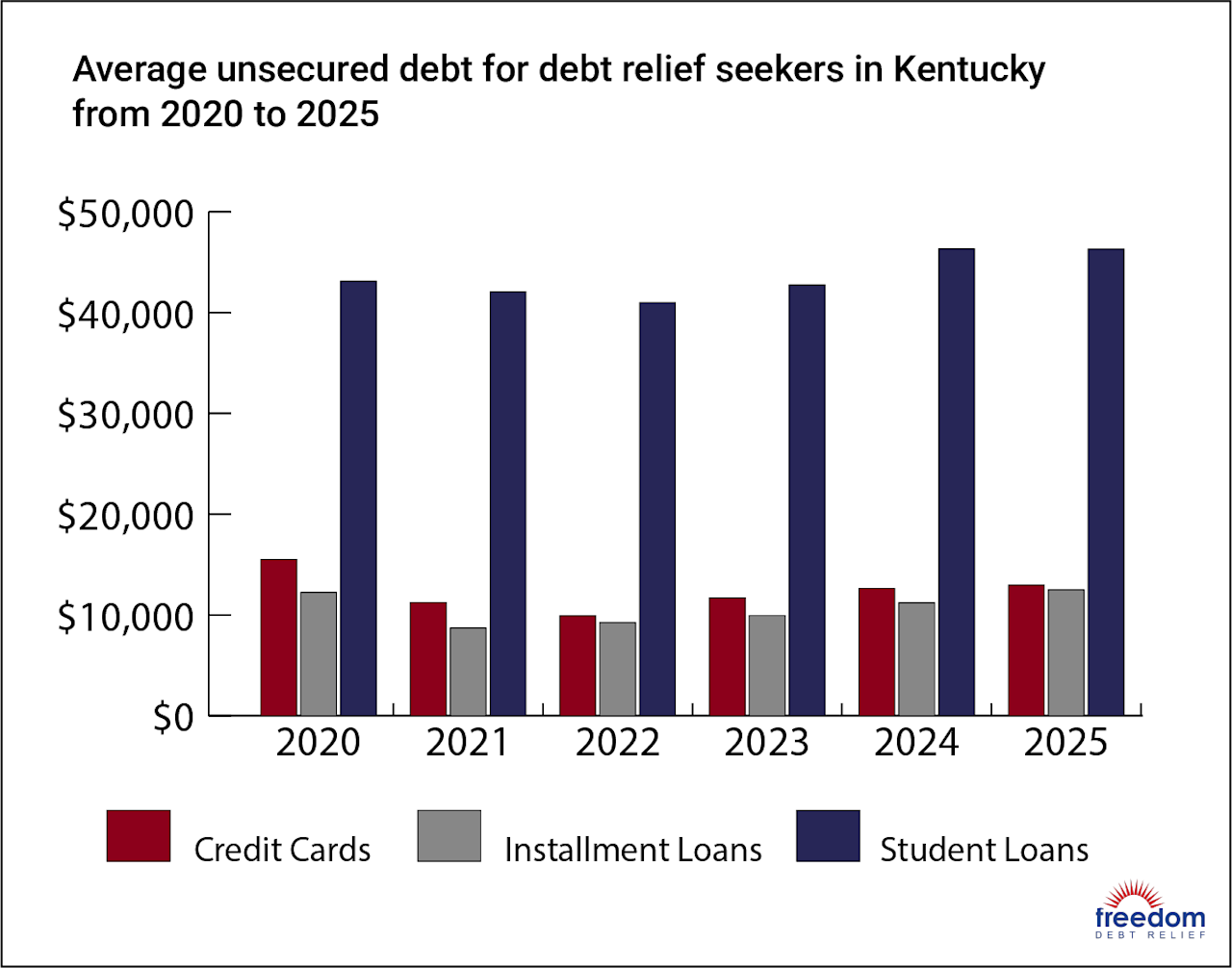
Credit card debt is not always the biggest burden for people in Kentucky seeking debt relief. The average Kentucky monthly credit card payment was $423 in 2024, lower than the national average of $487. People in Kentucky looking for debt relief also saw their average credit card balance get smaller during 2020 to 2024, from $15,527 to $12,640. That’s a big decrease of 18.6%.
Kentucky debt relief seekers had a bigger reduction in credit card debt than the national average. The average American seeking debt relief had a credit card balance of $16,553 in 2020, and a credit card balance of $15,636 in 2024, for a decrease of only 5.5%.
However, Kentucky debt relief seekers are using more credit than the national average. Freedom Debt Relief data shows that people looking for debt relief in Kentucky were using 78.8% of their available credit in 2024, compared to the U.S. average of 75.7%. That means the average Kentucky debt relief seeker is using $7,880 of a $10,000 credit line, or $3,940 of a $5,000 credit line.
High credit utilization shows that Kentucky debt relief seekers are feeling financially stretched. If you’re maxing out credit cards or using too much of your available credit, this can be a sign that you might need credit card debt relief.
Kentucky auto loan debt
The cost of car ownership is becoming a big cause of America’s struggle with affordable cost of living. As cars have gotten more expensive, auto loan balances and monthly auto loan payments have gone up year after year. The national average auto loan balance for U.S. debt relief seekers went up from $22,534 in 2020 to $26,839 in 2024, for an increase of 19.1%.
Kentucky is part of this national trend of higher auto loan costs. The average auto loan balance for Kentucky debt relief seekers was $22,022 in 2020 and $25,153 in 2024. But Kentucky’s average auto loan debt increase of 14.2% was lower than the national average.
Kentucky mortgage debt
Along with auto loans, Kentucky debt relief seekers have experienced higher levels of mortgage debt in the past five years. The average person in Kentucky looking for debt relief owed a mortgage balance of $166,229 in 2024, with an average monthly mortgage payment of $1,356. Both of these Kentucky mortgage debt averages are lower than the national average for debt relief seekers. As of 2024, the average person seeking debt relief in the U.S. had a mortgage balance of $241,535 and a monthly mortgage payment of $1,949.
However, Kentucky debt relief seekers seem to be struggling with faster-growing mortgage debt balances. The national average mortgage balance for debt relief seekers went up by 23% during 2020 to 2024 (from $196,780 to $241,535). In Kentucky, debt relief seekers saw their average mortgage balance go up by 28.5% (from $129,339 in 2020). Unaffordable mortgages could make it harder for people to manage payments on credit cards and other unsecured debts that might qualify for debt relief.
Kentucky installment loan debt
Kentucky residents seeking debt relief have taken out installment loans in amounts that are slightly higher than the national average. The average installment loan balance for Kentucky debt relief seekers was $11,233 in 2024, with an average monthly payment of $473. Both of those are higher than the U.S. national average installment loan balance of $10,582 and monthly payment of $436.
Kentucky debt relief seekers also increased their average number of installment loan accounts during 2020-2024. In 2020, this group of people had an average of 2.2 installment loan accounts open. As of 2024, that Kentucky average had risen to 3.0 installment loans per debt relief seeker, which is slightly higher than the U.S. national average of 2.9. More usage of installment loans can be a sign that people are struggling to get access to credit, or that they are using personal loans for debt consolidation.
Kentucky student loan debt
Kentucky debt relief seekers had an average student loan balance of $46,336 and a monthly student loan payment of $262 in 2024. This average Kentucky student loan balance was 7% lower than the national average of $49,861 for debt relief seekers, and the monthly average Kentucky student loan payment was 12% lower than the U.S. average payment of $298.
People in Kentucky looking for debt relief have seen their student loan balances grow at a slower rate than the national average. The U.S. national average debt relief seeker had a student loan balance of $49,861 in 2024 compared to $42,151 in 2020—for an increase of $7,710 or 18.3%. Meanwhile in Kentucky, the average student loan balance for debt relief seekers only went up by $3,205, or 7.4%, during 2020-2024.
Kentucky Debt Delinquencies and Collections
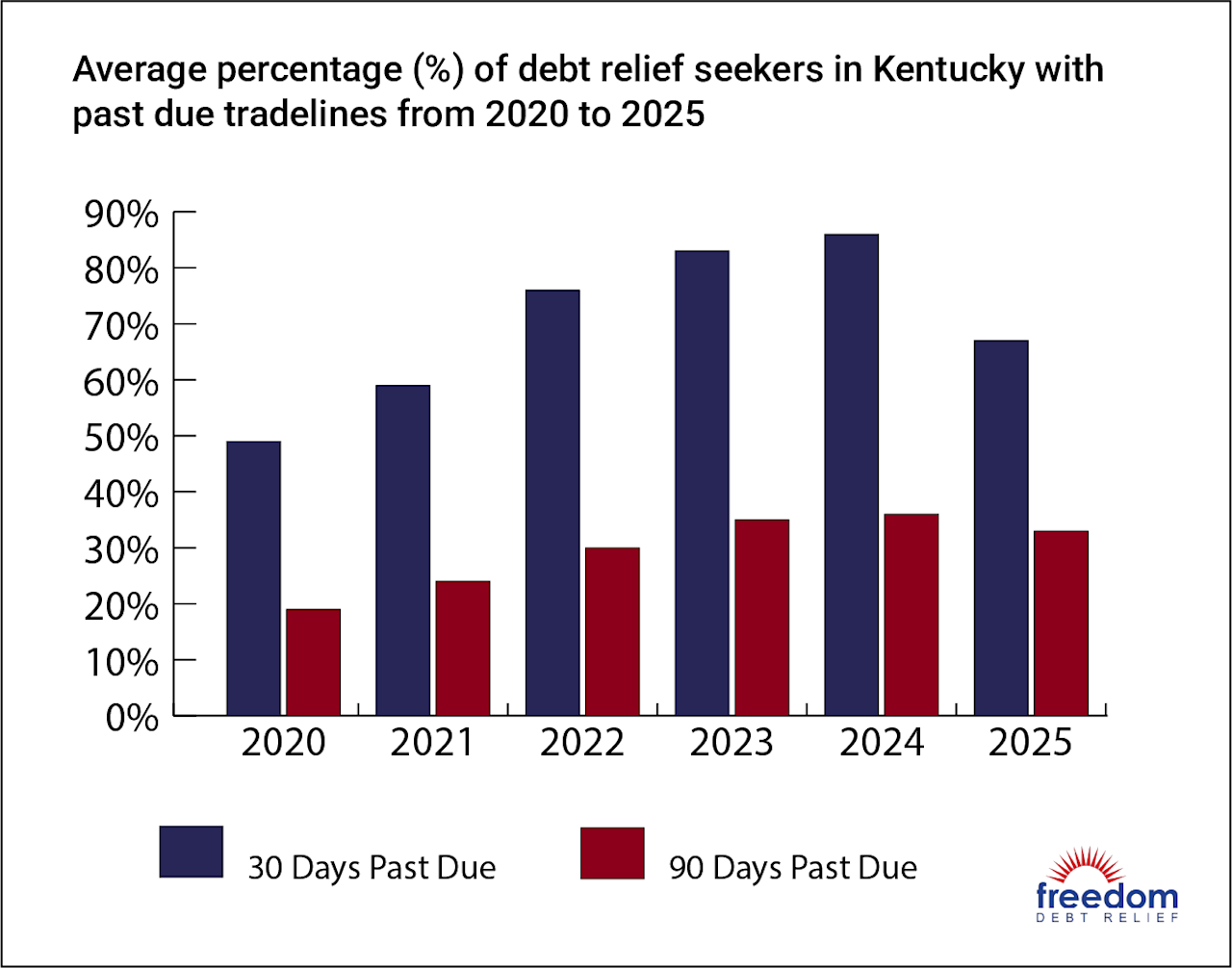
Kentuckians are slightly less likely than the average American to become delinquent on their auto loans, but more likely to fall behind on credit cards and mortgages. TransUnion data from September 2025 shows a mixed picture for how Kentucky debt delinquency rates compare to U.S. national averages.
Residents of the Bluegrass State have lower rates of delinquency on auto loans compared to U.S. national averages. Only 4.18% of Kentucky auto loan borrowers were at least 30 days past due (DPD), compared to 4.34% nationwide.
But Kentucky borrowers seem to be struggling more to stay current with their credit cards and mortgage payments. 5.01% of Kentucky consumers are at least 30 days past due on their credit cards, compared to 4.66% of credit card borrowers nationwide. Kentucky also has a higher mortgage delinquency rate than the national average. 3.20% of Kentucky borrowers are delinquent on their mortgage, compared to only 2.89% for the U.S. as a whole.
The table below shows Kentucky delinquency rates for auto loans, credit cards, and mortgages, with the percentage that are 30, 60, and 90 days past due.
| Type of debt | 30+ DPD | 60+ DPD | 90+ DPD |
|---|---|---|---|
| Auto loan | 4.18% | 1.61% | N/A |
| Credit card | 5.01% | 3.53% | 2.56% |
| Mortgage | 3.20% | 1.59% | 1.08% |
Some Kentucky debt relief seekers have already fallen behind on debt payments and have had credit accounts go to collections. However, the average collections balance for people in Kentucky looking for debt relief is lower than the national average. Kentucky debt relief seekers’ average collection balance in 2024 was $2,693, while the national average was $3,183. The average Kentucky debt relief seeker had 2.1 accounts in collections, which is in line with the national average of 2.0.
Kentucky Statute of Limitations
The Kentucky statute of limitations is the time limit for how long creditors and debt collectors can sue you for overdue debts in Kentucky. If your debt is so old that it’s beyond the statute of limitations, this is called having a time-barred debt. Creditors and debt collectors can’t sue you for debt that is past the statute of limitations. If your debt is time-barred, this can help you defend yourself in court against a debt lawsuit.
Kentucky state law has different statutes of limitations for different types of debt, ranging from five to 10 years. This table shows the Kentucky statute of limitations for the following types of debt.
| Type of debt contract | Kentucky statute of limitations |
|---|---|
| Written contracts (such as credit cards and auto loans) | 10 years |
| Oral contracts | 5 years |
| Promissory notes | 5 years |
| Mortgages and home equity loans | 15 years |
The Kentucky statute of limitations is complex, and there is some disagreement about Kentucky state laws and which types of debt contracts are covered by which statute. Kentucky debt collectors might tell you that they still have the right to sue you, even if you believe that your debt is time-barred.
Depending on your situation, you might want to talk with a Kentucky attorney who helps with debt collection and bankruptcy cases. An attorney can help you understand if your overdue debt is time-barred in Kentucky and how to defend yourself against a lawsuit.
What are the Kentucky debt collection laws?
There are no state-specific debt collection laws for Kentucky. However, people in Kentucky who get contacted by debt collectors are still protected by the federal Fair Debt Collection Practices Act (FDCPA). The FDCPA has rules for how debt collectors (including collection agencies, debt buyers, and attorneys) are allowed to contact and communicate with you.
Under FDCPA rules, debt collectors are not allowed to:
Harass you
Use obscene or profane language
Threaten you with violence
Contact you without identifying themselves as a debt collector and telling you their name
Contact you before 8 a.m. or after 9 p.m.
Talk to your employer, friends or family about your debt
Threaten to sue you if they don’t actually intend to, or don’t have the right to do so
If you believe that a debt collector has harassed you in an illegal way, or otherwise behaved in ways that violate the FDCPA, you can sue them for damages. Talk to a Kentucky debt collection lawyer if you believe a debt collector has violated your rights.
Reviews and Testimonials from Kentucky
This company literally saved me from drowning in debt. I couldn’t be more grateful for the workers that were always willing to talk thing through with me, and the company as a whole for taking me on as a client. I feel like I can finally breathe again!
Jace Duncan, US
Whole experience has been great.
Melissa J Houg, US
Timely and thorough notifications. Settlements have been reported with understanding and encouragement for me.
Roslyn H, US
Kentucky Debt Relief
If you’re falling behind on bills, getting calls from debt collectors, or going through other financial hardship, looking for debt relief in Kentucky can be a good move. Freedom Debt Relief offers Kentucky debt relief programs to help residents of the Bluegrass State (and people nationwide).
If you sign up for a Freedom Debt Relief debt settlement program, you can get professional help to negotiate with creditors to get rid of credit card debt and other unsecured debt faster than by making minimum payments. Debt relief programs are not the right choice for everyone in Kentucky, but Freedom Debt Relief can talk with you and help you learn more about whether you’re a candidate.
If Freedom Debt Relief’s debt settlement program is appropriate for your financial situation, you could sign up and enroll certain unsecured debts, such as credit card debt and medical bills.
Freedom Debt Relief will help you make a plan to save up cash with an affordable monthly deposit into a dedicated account that you own and control. That money will be used to make debt settlement offers to your creditors. The goal is to convince your creditors to accept less than you owe and forgive the rest. Freedom Debt Relief will do the negotiating for you. Getting professional help with debt settlement could help you get significant debt reduction and help you get on track for a better financial future.
Debt relief is not appropriate for every person’s situation. Freedom Debt Relief’s debt settlement program can only be used to help with unsecured debts (like credit cards, medical bills, unsecured personal loans, some private student loans, etc.). This kind of debt relief is only appropriate for people who can’t keep up with their debt payments and can’t afford to fully repay their debts. It’s meant to be used by people who have experienced serious financial hardship like medical emergencies, long-term unemployment, or other severe setbacks.
If you’re a good fit for debt relief and you stick with the program, you could complete your debt relief program in as little as 24 to 48 months. In 2020, Freedom Debt Relief customers in Kentucky enrolled an average of $26,350.
If you’re looking for Kentucky debt relief and want to learn more about this debt relief program, call Freedom Debt Relief at 800-910-0065. A Debt Consultant will talk with you about your overall debt situation and financial goals. If debt relief is appropriate for you, Freedom Debt Relief can help you understand your options for a debt relief plan to get rid of your debt.
Is Debt Consolidation the Best Debt Solution?
If you’re looking for debt relief in Kentucky, it’s important to keep in mind that different debt solutions are appropriate for different situations. Debt consolidation loans can be a good choice for people who can qualify for a lower-interest loan and who have steady income to pay off debt.
But if you are struggling with high-interest credit card debt, falling behind on bills, or getting calls from debt collectors, you might want to think about debt relief, such as a debt settlement program, instead of debt consolidation. Not everyone’s situation is the right fit for a debt settlement program. Some people might be better off with other debt solutions.
Here are a few debt solutions that might help you get rid of debt faster, depending on your financial situation.
Debt consolidation
With debt consolidation, you take out a new loan at a lower interest rate and use it to pay off multiple other loans all at once. Debt consolidation loans do not immediately get you out of debt. But they can lower your monthly payment, reduce your interest rate, cut down on the total amount of interest that you pay, and simplify your life with one payment instead of several debt payments.
If you’re juggling several credit card balances at once, and if you have a good enough credit score to qualify for a lower-interest loan, debt consolidation could be a good choice. For example, as of 2024, people seeking debt relief in Kentucky had an average of 7.2 credit cards open. If you’re struggling to make payments across several cards, a debt consolidation loan could make your financial life easier.
Some of the best choices for debt consolidation loans include a home equity loan or line of credit (HELOC), a personal loan, or a balance transfer credit card with a low introductory APR. But not everyone can qualify for a good rate on a debt consolidation loan. If you have less-than-fair credit, or if you’ve been declined for a debt consolidation loan, you might want to consider other debt solutions.
DIY debt payoff
Sometimes the best way to get rid of debt is just by paying it off yourself. The “DIY” debt payoff strategy can include different methods. Choose a debt payoff plan that fits your budget and suits your personality.
For example, some people love the debt snowball method, where you start by paying off your smallest debt first, even if it’s a lower-interest debt. This “snowball” can help you build momentum and feel more empowered to get out of debt as you watch your balances go to zero.
The debt avalanche method is a different debt payoff strategy. Instead of focusing on the smallest debt first, you start with the highest-interest debt. This way you save the most money on interest and create a top-down “avalanche” of momentum to pay off debt. For both methods, you continue making minimum payments on all your debts and funnel extra money to either your lowest balance or highest interest rate debt.
You don’t need a debt consolidation loan to do a DIY debt payoff. You just need a steady income, a clear budget, and strong determination to get out of debt, even if that means cutting back on fun money and convenient expenses.
Debt settlement
Some people have ended up in so much debt that they have no realistic way to pay it off. Being in debt doesn’t mean you made bad choices or were irresponsible. Many people rack up credit card debt and other personal debts because of bad luck in the job market or unforeseen medical expenses. People often get into credit card debt because of financial hardship and unfortunate events beyond their control.
But if you are struggling to pay your credit cards, if you’re falling behind on bills, if you already have credit accounts in collections and are getting calls from debt collectors, debt settlement might be a good debt solution. With debt settlement, your creditors agree to accept less than you owe on the debt. This debt solution can only be used for unsecured debts, such as credit cards, medical bills, and potentially some private student loans.
You could negotiate debt settlement yourself by calling your creditors, explaining your situation and asking them to settle your debt for less. But if you don’t feel comfortable having those conversations, don’t know how to organize your finances to make competitive settlement offers, or don’t know where to begin, a debt settlement program from a professional debt relief company could be a good choice.
It’s also important to know that debt settlement, whether you do it yourself or with a professional debt relief company, can have negative consequences for your credit. If you’ve already missed payments, however, your credit is likely already lower—and you can rebuild it after you’ve addressed your debts. If some of your debt gets forgiven by creditors, this can cause you to have to report higher taxable income on your tax return. There are no guarantees that creditors will accept a debt settlement offer.
Reputable debt relief companies will explain their fees (and won’t charge you upfront fees). Instead of making big promises, legit debt relief companies will answer your questions and show you how their program works in a clear, understandable way—including any potential risks and downsides.
Professional debt relief companies could help you get rid of debt faster with a well-organized plan. They might help you save time, save money, and get better results than you could achieve on your own.
Debt management plan
If you’re struggling with credit card debt and you don’t want to try to get rid of debt for less than you owe, you might want to try a debt management plan (DMP). This debt solution is offered by credit counseling agencies, which are nonprofit organizations that work with creditors on your behalf.
With a debt management plan, you agree to work with a credit counseling agency to consolidate your credit card debts and set up a customized payment plan with a monthly payment that fits your budget. The credit counseling agency then helps handle your payments to creditors and watches your progress.
A debt management plan (DMP) can be a good choice for some people. But if you struggle to make the monthly payment, your DMP might fail to solve your debt problem. For example, according to Freedom Debt Relief data, people seeking debt relief in Kentucky had an average monthly minimum debt payment of $1,438 in 2024. Unless a DMP can help you save big money and free up extra cash in your monthly budget, you might fail to complete the plan. Other solutions could be better ways to help people with severe debt problems get rid of debt faster.
Bankruptcy
Many people looking for debt relief in Kentucky might be reluctant to file bankruptcy. You might think of bankruptcy as a last resort. But filing bankruptcy can be the best choice for debt relief for some people. If you have no reasonable way to pay off credit card debt and other debts, bankruptcy can help you discharge some (or all) of your debts, depending on your situation.
Keep in mind that bankruptcy does not automatically get rid of all types of debt. Different types of bankruptcy might require you to sell property or make a partial re-payment plan with your creditors. Filing bankruptcy is a serious negative event on your credit history that can stay on your credit report for up to seven to 10 years. But it could be the best choice for people with the most serious debt problems.
Talk to a bankruptcy attorney if you think bankruptcy might be a good choice for you. It is possible to rebuild your credit after bankruptcy. Sometimes seeking the legal protection of bankruptcy can be the best way to get rid of debt and move forward in life.
Kentuckian can free up cash each month with Freedom Debt Relief
Ozzy S., Freedom client²
“Right away, I had more money each month because of program costs so much less than what I was paying on my minimums.”
Excellent •
Is Freedom Debt relief a legit company for Kentucky debt relief?
Freedom Debt Relief is a legitimate professional debt relief company. It offers debt settlement programs to help you get rid of debt faster by negotiating with creditors on your behalf. Freedom Debt Relief is accredited by the Better Business Bureau with an A+ rating. It also has earned thousands of positive customer reviews, with a rating of 4.6 out of 5 stars on Trustpilot. Freedom Debt Relief is also listed on the Kentucky Attorney General’s list of Registered Debt Adjusters.
What is the debt collection law in Kentucky?
People in Kentucky are covered by the federal law, the Fair Debt Collection Practices Act (FDCPA). This federal law puts limits on how debt collectors can contact you and how they can behave toward you. Even if you are overdue on debts, you still have rights and deserve to be treated fairly and respectfully.
How bad will Kentucky debt relief hurt my credit?
Debt settlement and bankruptcy will both appear as negative marks on your credit report and will almost certainly lower your credit score. Debt settlement may have less of an impact than Chapter 7 bankruptcy on your credit scores over time. Chapter 7 bankruptcy stays on your credit reports for ten years. Late payments and “settled” notations stay on your credit reports for seven years.
How much debt settlement lowers your score depends on your starting score. If you're already missing payments, then the debt settlement process may not hurt you much. If you have a perfect history of on-time payments, stopping payments and settling your debts could cause your credit score to drop significantly. Once your debts have been settled and your finances are stable, your credit score could increase over time if you pay on time, keep your credit card balances low, and avoid applying for credit until you need it.
Freedom Debt Relief isn't a credit repair organization and doesn't provide, or offer, services or advice to repair, modify, or improve your credit.
End Your Debt
Find out how our program could help.
- One low monthly program deposit

- Settlements for less than owed
- Debt could be resolved in 24-48 months