
Illinois Debt Relief By the Numbers: 5-Year Debt Trends
Illinois has the 21st lowest cost of living in the United States, with the average cost to live in the state coming in at $58,333 according to SoFi.
The state's low cost of living may be one reason why Illinois residents have below-average debt levels. The average person in Illinois owed $53,400 in 2024, which is $8,300 less than the average American.
Unfortunately, while Illinois residents on the whole have below-average debt, many people are still struggling with a debt burden that is too high.
To better understand what kinds of debts Illinois residents are facing, let's take a look at debt trends in the state based on information collected from debt relief seekers by Freedom Debt Relief.
Illinoisans can free up cash each month with Freedom Debt Relief

Ozzy S., Freedom client²
“Right away, I had more money each month because of program costs so much less than what I was paying on my minimums.”

Excellent •
Debt Trends in Illinois
Illinois data shows some disturbing trends, as residents seeking debt relief have been falling more deeply into debt and have significantly more debt than the national average.
Illinois residents seeking debt relief had $32,875 in estimated debt in 2024, up from $24,899 in 2022. This is significantly higher than the national average debt of $26,573 among all debt relief seekers in 2024.
The good news is, despite this larger debt burden, FICO credit scores in Illinois among debt relief seekers are slightly higher than the national average, coming in at 591 in 2024 compared with an average 581 score nationwide during the same year. This is still considered a fair score, although the national average score among debt-relief seekers is trending very close to being considered poor.
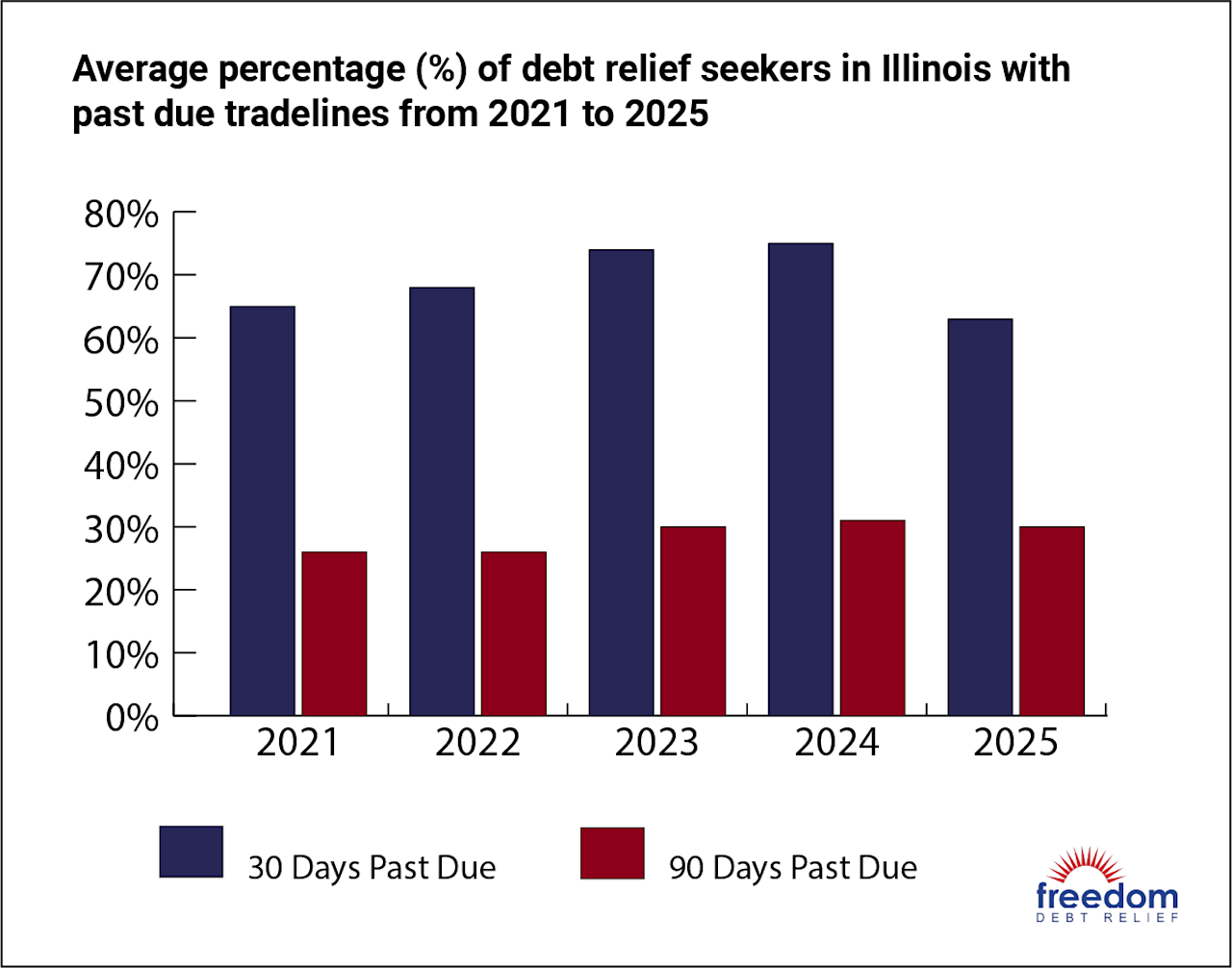
Unfortunately, the percentage of debt relief seekers in Illinois with accounts that are 30 days past due has grown from 70% in 2022 to 80% in 2024, but this is on par with the 80% national average, so it's not unexpected. Past-due accounts can damage your credit, but creditors may be more willing to work with you to negotiate debt settlement when you are behind on what you owe, as it shows evidence of financial struggle.
Illinois credit card debt
Credit card debt can be particularly stressful because of the high interest rates that are typical with consumer credit cards, averaging over 20%.
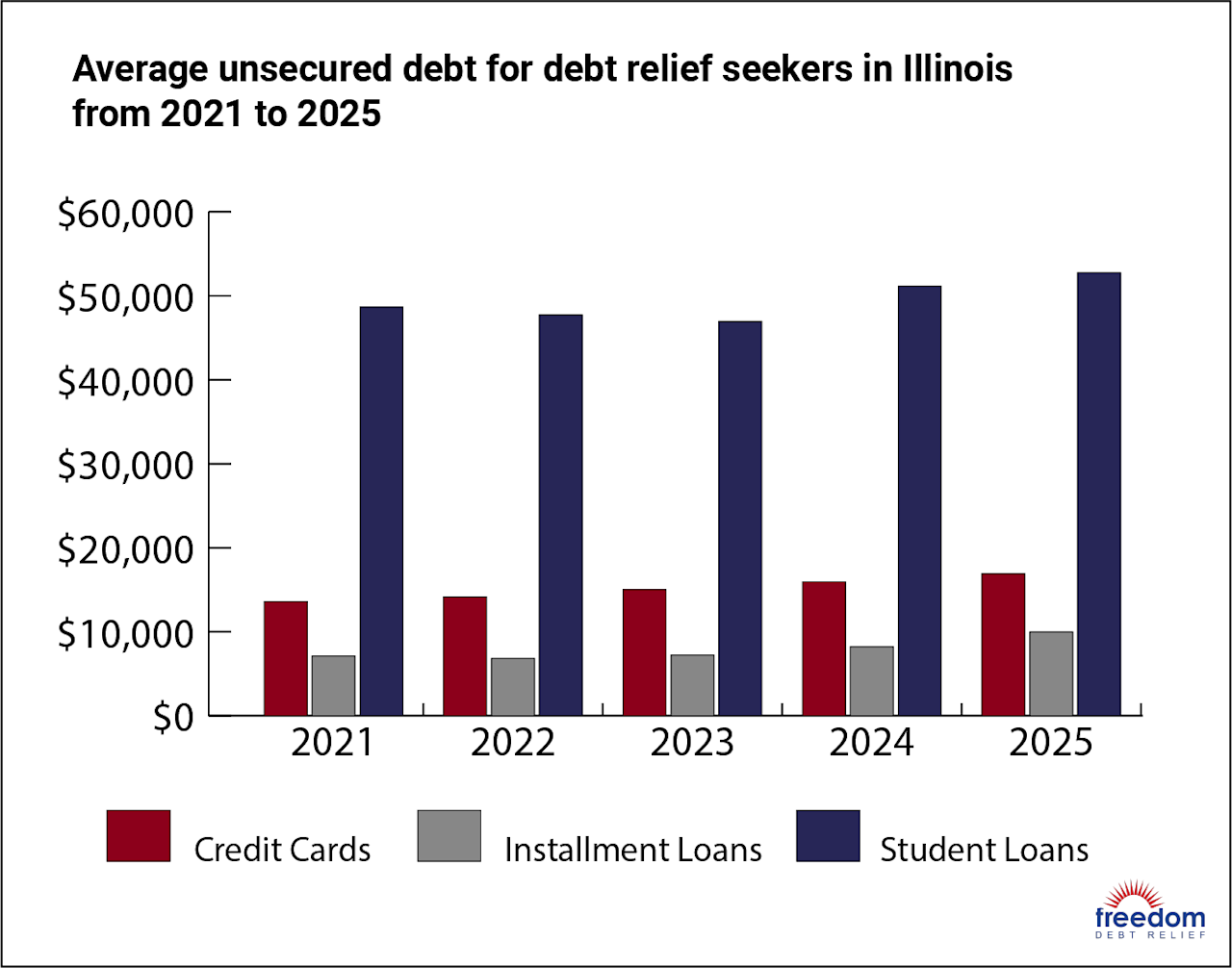
Unfortunately, average credit card balances among debt relief seekers in Illinois have increased substantially in recent years, jumping from $14,151 in 2022 to $15,041 in 2023 and $15,942 in 2024. This puts the average credit card debt above the national average of $15,636 in 2024.
It's not surprising that state residents have more debt than average, as Illinois residents have an average of eight open credit cards in 2024, compared to the 7.6 open cards nationwide. With these higher balances come higher payments. Illinois residents face monthly payments averaging $456 in 2024, up from $422 just a few short years ago in 2022.
Illinois residents are clearly struggling with this debt, as they have an average of $5,215 in past due balances on their credit cards. Their credit utilization ratio of 73.5% in 2025 is also far higher than the recommended ratio, which is 30% or less. A credit utilization ratio of 73.5% means a balance of $735 on a card with a $1,000 credit limit.
It can be hard to dig out of the hole, but there are credit card debt relief options available, including letting Freedom Debt Relief negotiate with your creditors to pay less than you owe if your balance is too high to pay.
Illinois auto loan debt
Auto loan balances have been increasing nationwide, with the average car loan balance among debt relief seekers increasing from $24,979 in 2022 to $26,839 in 2024.
Illinois trends mirror the national average as balances have been increasing—but residents in the state have smaller balances than the nationwide average. The average owed on auto loans among Illinois residents in 2024 was $24,902, up from $23,749 in 2022.
Still, Illinois debt-relief seekers have an average of 1.4 auto loans and an average monthly payment of $590, which can be a major financial burden to take on, as car payments are just the start of transportation costs. There's also gas and insurance on top of a monthly car payment that's nearing $600.
Illinois mortgage debt
Mortgage debt is not usually seen as a big problem. It has a lower interest rate than other kinds of consumer debt. Plus, you're paying for a house, which is an asset. Still, it can add to your debt burden.
The good news for Illinois residents seeking debt relief is that their average mortgage balance, which totals $186,012, is well below the national average monthly mortgage balance of $241,535.
Since loan balances are lower, it's not surprising that Illinois residents pursuing debt relief also have lower monthly mortgage payments, with those payments averaging $1,697 in 2024 compared with $1,949 nationwide.
Mortgage debt usually cannot be settled or discharged in bankruptcy if you're keeping the house, so it is a positive sign that payments and debt balances in Illinois are below average statewide—even if balances have grown substantially since 2021, when the average was just $170,256.
Illinois installment loan debt
Installment loans are repaid on a set schedule and are usually, but not always, unsecured. Illinois residents don't owe a lot on installment loans, but balances have steadily grown from $6,825 in 2022 to $8,221 in 2024. These balances are well below the $10,582 nationwide average installment loan debt in 2024.
Illinois residents seeking debt relief also have affordable average payments at $165 per month compared with the $436 nationwide average in 2024. The fact that payments are affordable, though, doesn't mean that you should necessarily rely on this debt for the long term. You're still paying interest and have committed some of your current income to covering past purchases, which affects your future ability to live within your means.
Illinois student loan debt
Although lawmakers have at various times promised student loan forgiveness, student loan debts remain due for borrowers.
In Illinois, the average student loan balance among debt relief seekers has increased from $47,739 in 2022 to $51,168 in 2024, while monthly payments have grown from an average of $62 to $168 during this same time period.
This is above the national average of $49,861 in 2024 among debt relief seekers—but Illinois payments are still lower than the nationwide average of $298 per month in 2024. This is surprising, given that Illinois residents have slightly more student loan tradelines—5.5 on average in 2024 compared with an average of 5.4 loans nationwide.
The lower monthly payments could mean a lot of Illinois residents seeking debt relief who have student debt have chosen income-driven repayment plans that cap payments at a percentage of income. These plans can keep costs lower.
Illinois Debt Delinquencies and Collections
Unfortunately, there has been a sharp increase in Illinois debt relief seekers who are 30 days past due on debt payments in recent years, with this number jumping from 70% with past-due tradelines in 2022 to 80% in 2024. Being past due means you face collection activities. You will also have your late payments reported to the credit reporting agencies.
The good news is, although more borrowers in Illinois are falling 30 days behind, there has been no increase in the percentage of people with debt they are more than 90 days behind in paying. Both in 2022 and 2024, 30% of borrowers were 90 or more days late.
The 80% and 30% ratios of borrowers who are 30 and 90 days behind are exactly the same as the nationwide average, so Illinois residents are about on par with their peers in terms of late accounts. However, the average past-due amount in collections is $3,016 in Illinois in 2024, compared with $3,061 nationwide, so Illinois residents have very slightly smaller debt balances in collections.
Illinois debt-relief seekers also have slightly fewer accounts in collection, with 1.9 reporting open tradelines in collections compared to 2.0 reporting the same on the national level. Still, having any accounts in collections can be stressful.
Illinois Statute of Limitations
Illinois law establishes a statute of limitations for debt collection. Debt collectors who don't collect from you before the time deadline established in the statute of limitations ends lose the right to take legal action against you for that debt. They could still try, though. If you’re sued for an old debt and you think the statute of limitations has passed, you could ask the judge to throw out the lawsuit.
The statute of limitations in Illinois varies based on the type of debt you have. The table below shows how long collectors have to take successful action based on what kinds of loans you're behind on.
| Type of Debt | Illinois Statute of Limitations |
|---|---|
| Written contracts, including promissory notes and written leases | 10 years |
| Unwritten debts and credit cards | 5 years |
| Student loans | 10 years |
| Legal judgments | 20 years |
| Mortgage foreclosure | 10 years |
If the statute of limitations says your debt is time-barred, or if you are close to the statute of limitations expiring, be cautious about repaying debt as you may reset the clock.
What are the Illinois debt collection laws?
The Illinois Attorney General states that the federal Fair Debt Collection Practices Act, the Illinois Collection Agency Act, and the Illinois Consumer Fraud and Deceptive Practices all provide protection from certain kinds of collections activities when you have fallen behind.
Debt collectors are not allowed to:
Contact you at unreasonable times, such as before 8 AM or after 9 PM, unless you agree
Harass, oppress, or abuse you
Engage in unfair practices like forcing you to accept collect calls
Collectors also can't continue contacting you if you send them a letter within 30 days after they first make contact, stating that you don't owe the money—unless they send you proof of the debt’s validity.
And you can request collectors stop contacting you entirely even if you owe money. They can keep trying to collect, including by taking legal action, and they can notify you if they will be taking any specific actions against you. But they can't just call you to ask you to pay your bills if you tell them to stop.
Illinois Debt Relief
Illinois residents who are in need of debt relief can reach out to Freedom Debt Relief to ask about options to address their debt.
Freedom Debt Relief could help you find a debt relief provider to help you negotiate with your creditors to pay less than the full balance.
Freedom Debt Relief has referred tens of thousands of debt relief seekers to trusted partners. In 2024 alone, we helped more than 3,300 people in Illinois find the resources they needed.
As debt balances climb in the state, Freedom Debt Relief is available to help the increasing number of Illinois residents who are struggling find a solution.
Is Debt Consolidation the Best Debt Solution?
When you are exploring debt relief options, it's important to weigh the pros and cons of each one. Here are the primary options:
DIY debt relief: This usually involves creating a plan to make strategic extra payments on your balances. It is a good solution if you don't have more debt than you can repay and if you simply need a structured approach to paying back your creditors quickly.
Debt consolidation: This involves getting a new loan to repay your existing debts. It can work if you have at least fair credit and can qualify for a new loan at a more affordable rate and if you can make payments each month toward your debt.
Debt management plan: A debt management plan is usually made as part of credit counseling. Your credit counselor will work with your creditors to create a payment plan that may involve some lowered interest or waived fees. You'll make one monthly payment that's distributed to creditors.
Debt settlement: Debt settlement involves negotiating with creditors to pay less than the full amount due. It is a good option to consider if you have a financial hardship and you can’t afford to fully repay your debts.
Chapter 7 bankruptcy: Eligibility depends on your financial means, and you will have to liquidate assets. However, you can get debt forgiven quickly this way.
Chapter 13 bankruptcy: If you can't qualify for Chapter 7 bankruptcy, you can file for Chapter 13 bankruptcy. This process involves creating a three- to five-year repayment plan to pay back creditors.
Illinoisans can free up cash each month with Freedom Debt Relief
Ozzy S., Freedom client²
“Right away, I had more money each month because of program costs so much less than what I was paying on my minimums.”
Excellent •
What should you do if debt is passed the statute of limitations in Illinois?
A debt collector cannot sue you and expect to win in court if the statute of limitations has expired in Illinois, although they may still try. If a debt collector sues you and you ignore the summons, they might win a default judgment against you. Then they would have a legal right to collect on that judgment.
If you receive a summons in the mail, don’t ignore it. Talk to an attorney about how to proceed. Your attorney might ask the judge to throw out the lawsuit if the statute of limitations has passed.
You can request that a creditor stop contacting you. If you do this, their only option may be to file a lawsuit. So it’s not a good idea to tell them to cease contact unless you're 100% certain that you're willing to take that chance. Be careful about making any partial payments, as this could potentially reset the statute of limitations.
How do you ask for a debt to be forgiven?
Illinois lenders won't usually forgive debt entirely. However, you may be able to negotiate a more affordable repayment plan or agree to settle debt for less than you owe.
You are more likely to be successful with making this type of agreement if you provide evidence of financial hardship. You can work with a company like Freedom Debt Relief for help negotiating a debt settlement.
How long can debt collectors try to collect in Illinois?
Debt collectors can no longer take collection activities against you if the statute of limitations has expired. The time deadline for collectors to act depends on the kind of debt and is between five years (for debt like credit cards) and 20 years (for judgments against you).
End Your Debt
Find out how our program could help.
- One low monthly program deposit

- Settlements for less than owed
- Debt could be resolved in 24-48 months